

As any overlander who has spent significant time on the road knows, there is a lot of preparation involved in an overland adventure. A lot of preparation. But no one prepares for a pandemic. No one.
In our case the plan was simple: circumference the African continent in a year or so. Drive north up the west coast, and across through Europe, then drive south down the east. Simple enough. We would have left out the European bit if we could cross Libya…but that was a no go because of the civil war there.
In all the preparation we did, no one could have even imagined what would happen in a market in Wuhan in China in December of 2019. Least of all us. We were free spirited travellers. Lost in our bubble of pleasure zone ignorance. At sea, blissfully floating across countries whose people speak with a foreign tongue. We were scarcely listening. Not to the news or to anyone really. That’s how you roll in an adventure into the depths of African remoteness. There is so much going on in front of your vehicle you cannot rest for a minute. And what happens outside the windshield is way more riveting and captivating that any news broadcast. In retrospect we were blissfully and comfortably ignorant to the first signs of the pandemic.
On reflection, the way we first felt the signs of the pandemic was on the Sierra Leone border crossing. We had taken a left turn from Guinea and a big chance to enter Sierra Leone on a remote north easter border without either a visa or the right to drive a right-hand drive vehicle. We were totally illegal. So our game was to make ourselves legal. And you do that by being kind and open and warm to the border officials. When we arrived we swamped them in hugs and high fives. And they pulled back and directed us to a bucket of water under a tree to wash our hands. Once washed all the hugs were restored. I never knew why they did that till weeks later when, sitting on Burrough Beach south of Freetown, another traveller said something about there being a virus and it was spreading from China to Italy. That was it. That’s all we knew. Didn’t seem like much of a problem from the distant shores of West Africa.
It was early March when we finally crossed from Guinea into Senegal. We were elated. Not a worry in the world. We had triumphed over the hill of a dual passport at the Senegalese border and had my Irish safely stamped well before our Morocco crossing. Before us lay the last stretch of the journey across the bulge of West Africa and on into Morocco. All the hard work was done. We were feeling like we were at the cusp of our halfway mark in our circumference Africa adventure. About us the landscape had changed. Savanna and semi desert dry shrub peppered the earth. We hadn’t been driving in Senegal for long and we were embraced by clouds of snowflake like white seedlings from the kapok trees blowing across the road. It was magical. Like some kind of natural welcoming to the Sahara blessing. At least that’s what we thought.
We were so enamoured by being in Senegal, seeing the beautiful traditional boubous the citizens were wearing, that we stopped in the first village shop to deck ourselves out in traditional boubou garb. The proprietor welcomed us warmly and took us through countless options of outfits and colours to assist our selection process. It felt good. Sitting on a small bench in his store on the side of the road, trying on various garments, taking pictures and laughing with the shop owner, affirming the creativity of his tailors. It was good, it was real and authentic. We felt accomplished and present in ourselves.
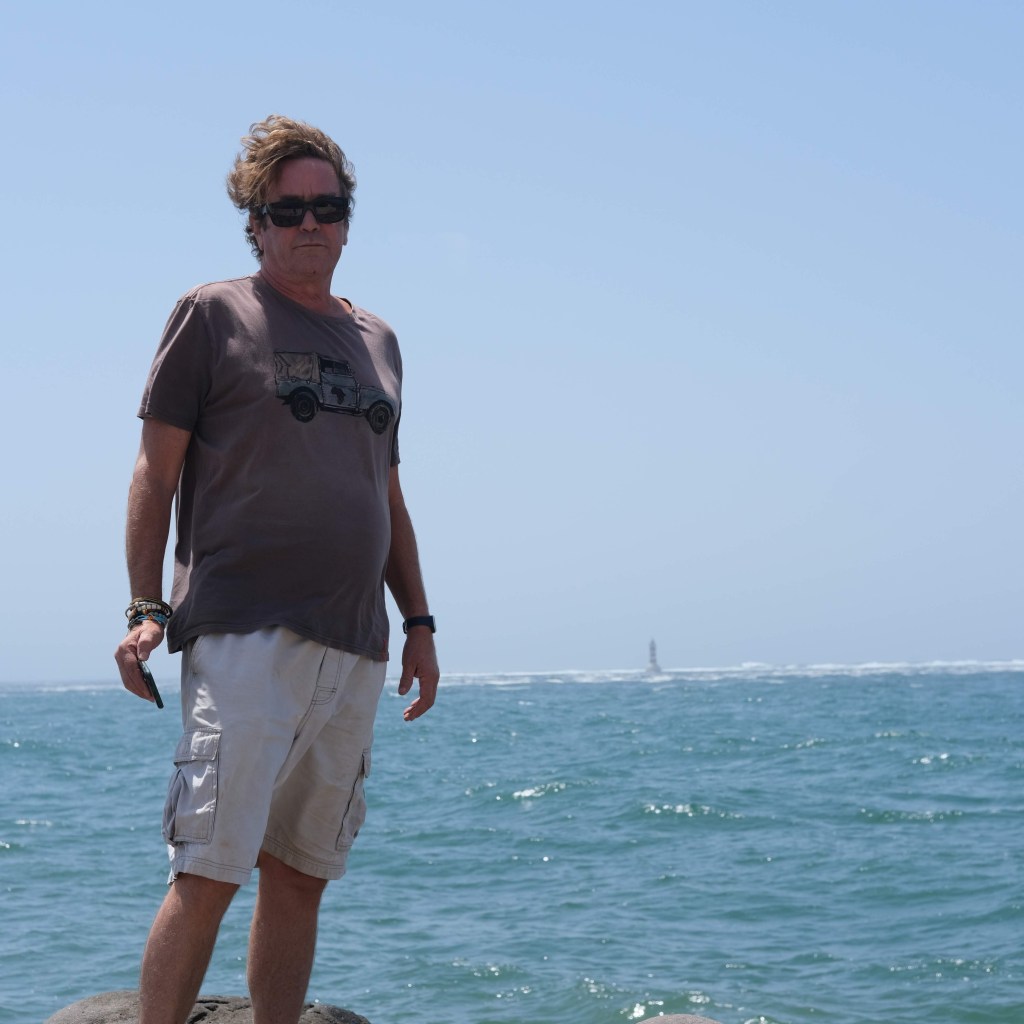
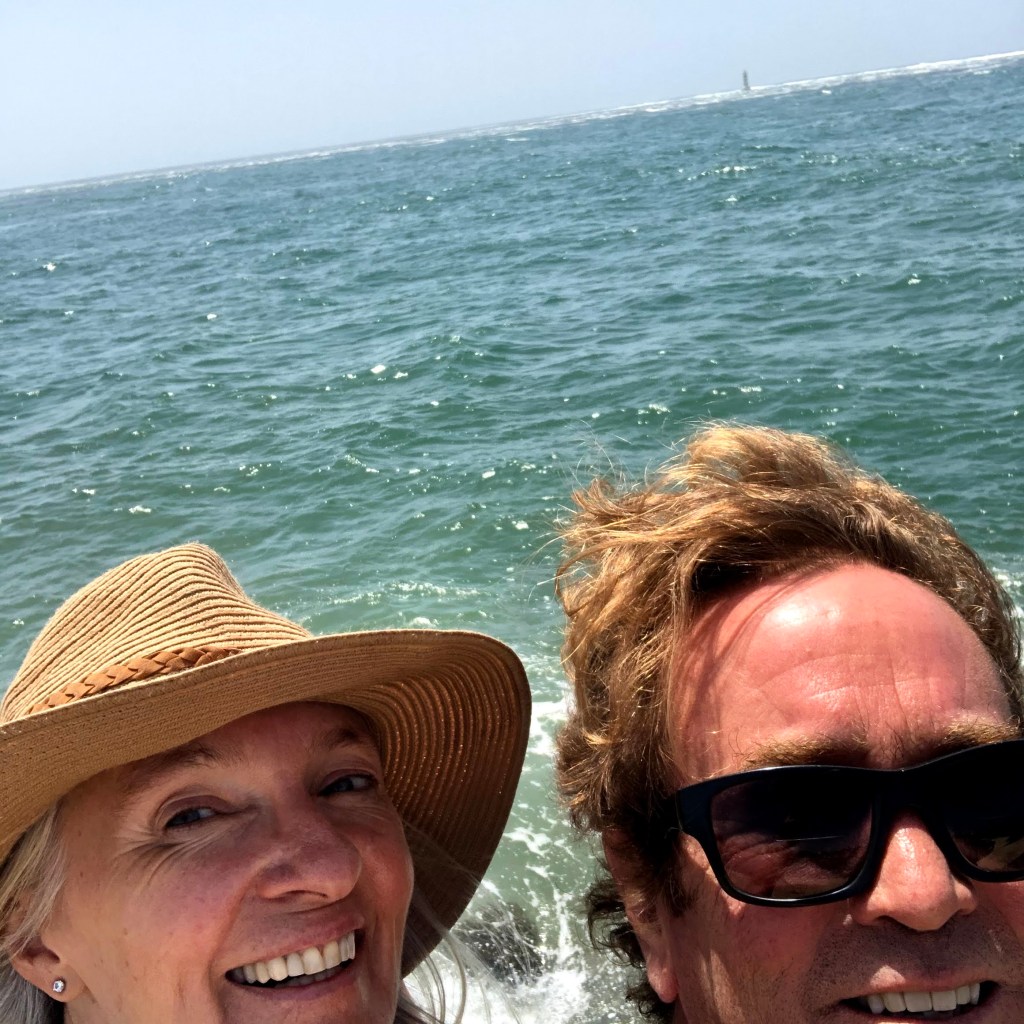
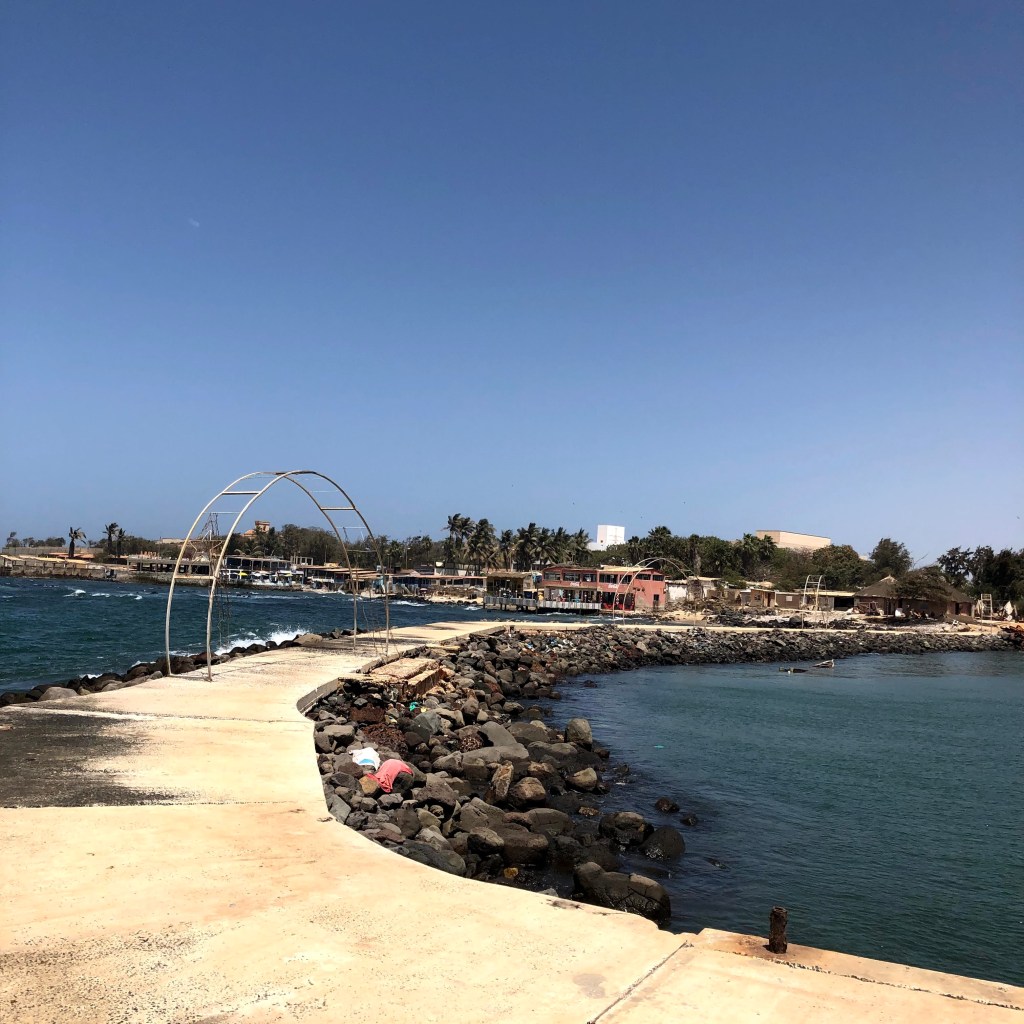
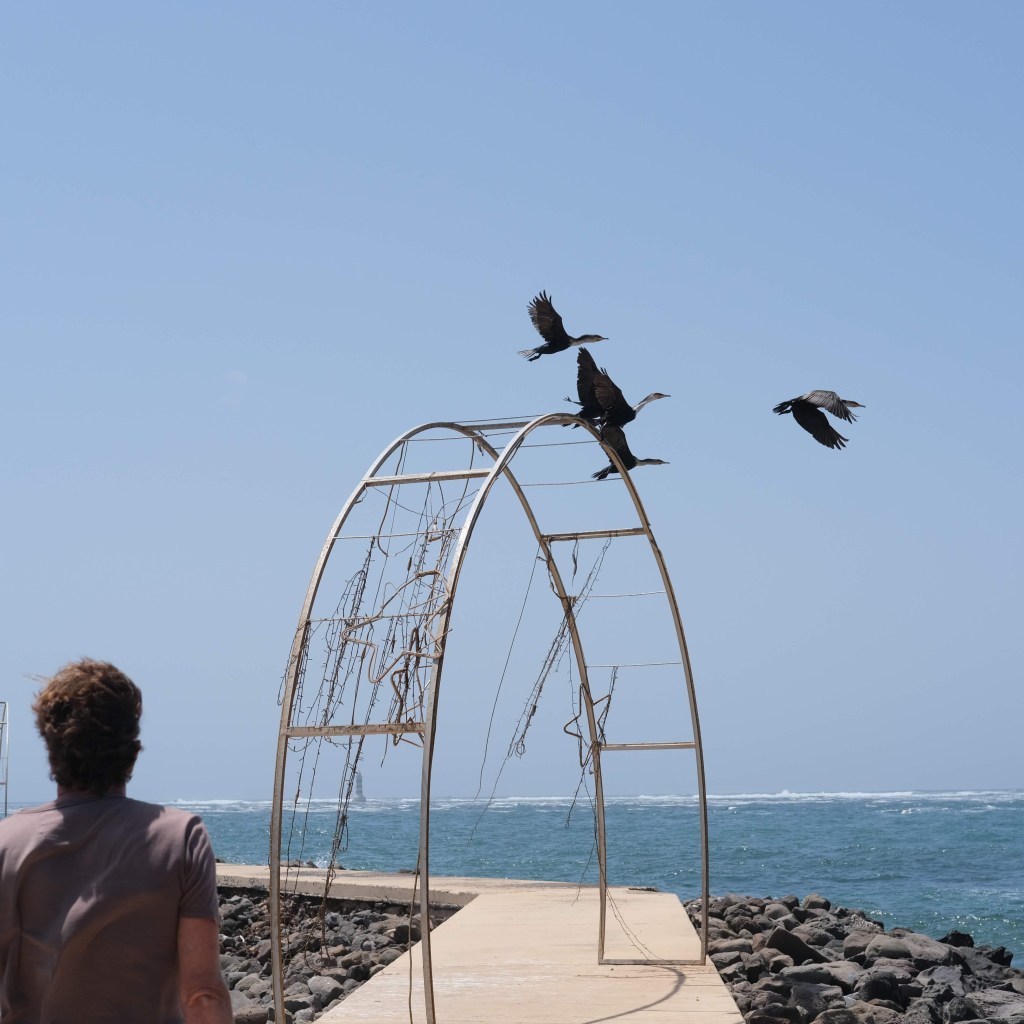
We left the village and decided to head west to the coast of Senegal and then tracked north again into Gambia to get more stamps in our passports and see another country. We were on a roll. Driving east to the coast across the huge wetlands and estuaries we drove past piles and piles of oyster shells littering our path. In the evening we camped out in the yard of our Senegalese back packer patrons and the next day drove on into Gambia for some prawn like shrimp lunch at a wildlife resort on the banks of the Gambia River. Then we headed north again to Dakar and headed straight for the most western point of the African continent. The point was appropriately adorned with countless kiosks and stores selling curios to tourists. We headed out onto the promenade and walked to the end of the peninsula, to stand on the most extreme far western point of the African coastline and take the customary selfies of ourselves rather triumphantly. We looked like this:
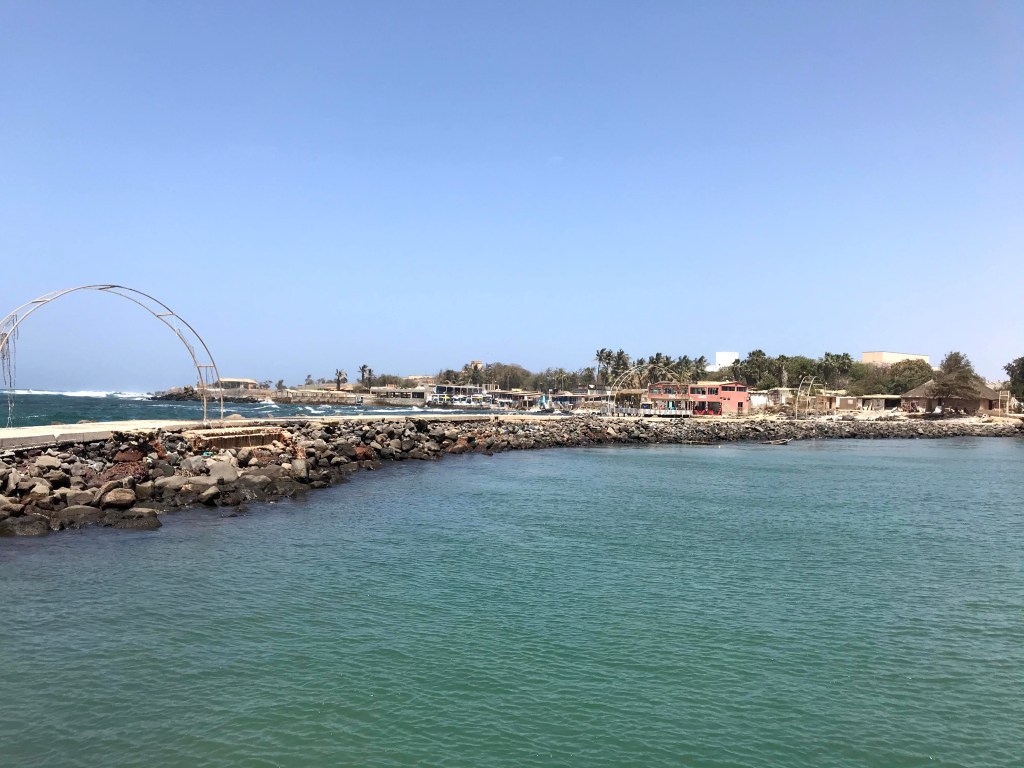
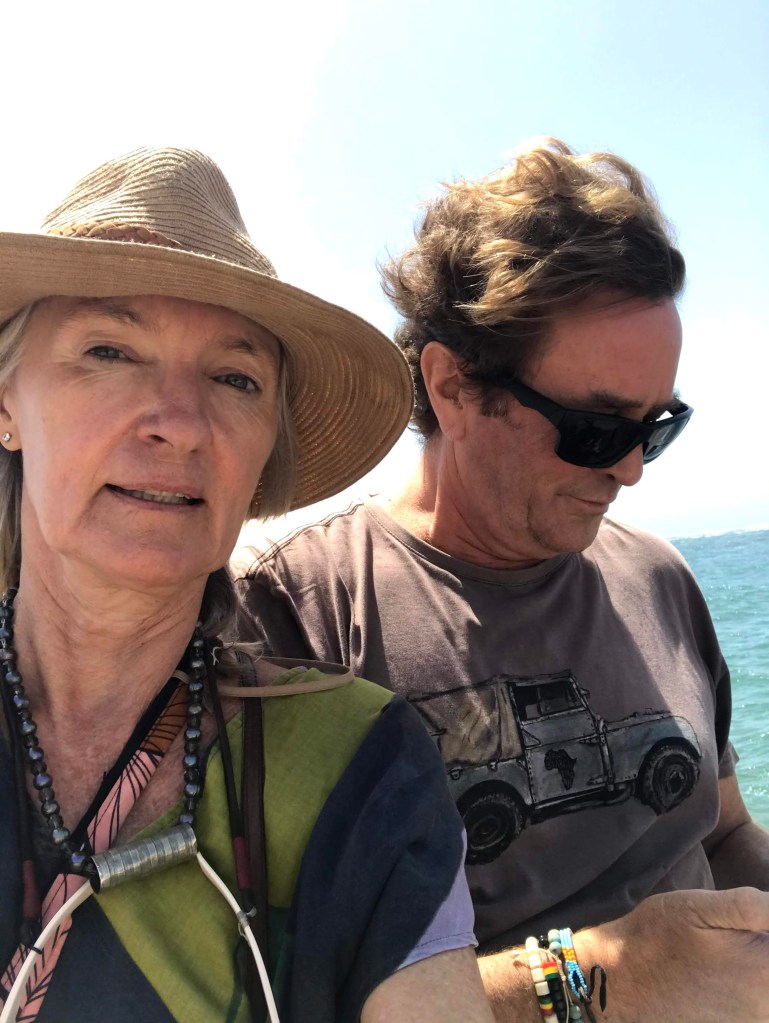
Heading back into the city we went in search of our backpacker’s abode in downtown Dakar. It took a while to find the place and a squeeze to fit the Troopy onto a pavement near the hostel. No-one was disturbed. Everyone signalled and guided us through countless minute, squeeze like, turns to fit us onto a tiny piece of pavement. We entered the youth hostel to fund it deserted. “Everyone gone home” said the hostess, “because of Covid pandemic”. We were shocked. But thought they are Europeans, they are over reacting. Why leave when the virus had just entered Italy? A million miles away. Nothing to worry about at all.
We were to be rudely shocked later that evening in a call from our algorithm brain driven son, Jason. He tells us in his serious, concerned and decisive way: “This is serious. You need to get out. Your trip is over. There is nothing to discuss, except whether to ship the Troopy out or leave it in Dakar. But you need to leave. And leave now. Immediately. The forward projected numbers show that millions will be impacted by the virus across the globe. The US will be very badly affected, as will the rest of the world.”
It sounded like an extreme over reaction. This is in early March. There is no virus in the US yet. None in Africa. Lots in northern Italy and in the virus home country of China. So we are shocked by his reaction, but not alarmed. It seems to us he is likely exaggerating. Being extra cautious self as usual. At least that’s what I thought in the moment. No sooner had we put down the phone and I was already thinking how to get to Morocco as quickly as possible.
Suddenly there is a lot going on. In a heartbeat our carefree selves are being asked to be responsible and abandon ship. My son is serious and concerned. We have no way of assessing if his concerns are accurate or not. Our youth hostel is empty. The proprietor is looking worried. She seems to be shutting shop. What could that mean? We have other hopes milling around in our head. We have been offered limitless accommodation at an olive and pony farm forty kilometres outside Marrakesh. “What’s not to love about that?” I think. All we have to get to the olive farm and rest and enjoy Morocco for a few months till the virus blows over. Seems imminently doable.
We start to discuss our options for the first time. And we resolve that the olive farm is where we will head to and hide out. We can’t turn back. It’s too late for that. We are 27,000 kms deep into west Africa. No one turns back from that. But I should have a backup plan. Maybe post an appeal to Facebook asking if anyone knows where I can store my Troopy. Just in case. We don’t really believe in the back up. But we do it anyway. Then we switch our phones off the next morning and head north out of Dakar after a mere two nights. We feel we wanna get to Morocco. We must get there. It’s only about two and a half thousand kilometres to Marrakesh. That’s a four-day drive max. This is totally doable. At least that’s what I was thinking.
The road north from Dakar is good. We make solid progress in a day of driving. Our destination is Djoudji National Bird Sanctuary in northern Senegal, a stone’s throw from the border to Mauritania. This bird park is renowned for being the stop over refuelling wetland for millions of intercontinental migrant birds. This is where they rest on their long journey north or south. So we are thinking let’s go and camp in the park for a few days and then gently head into Mauritania and on to Morocco in a two-day drive north from the park. That would mean we would arrive at the border exactly on the start date of Lou’s Morrocan visa. Perfect. Sounds good. We are excited. The virus has disappeared from our consciousness. We on the road north. On the road to a safe home. Or so it seems.
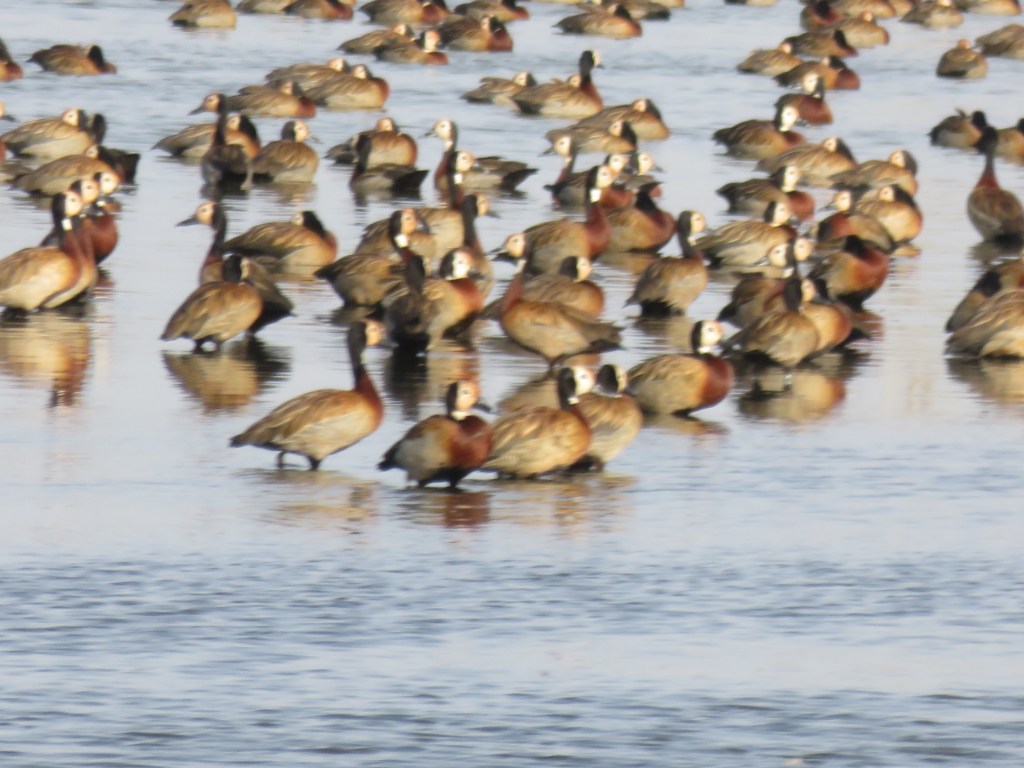
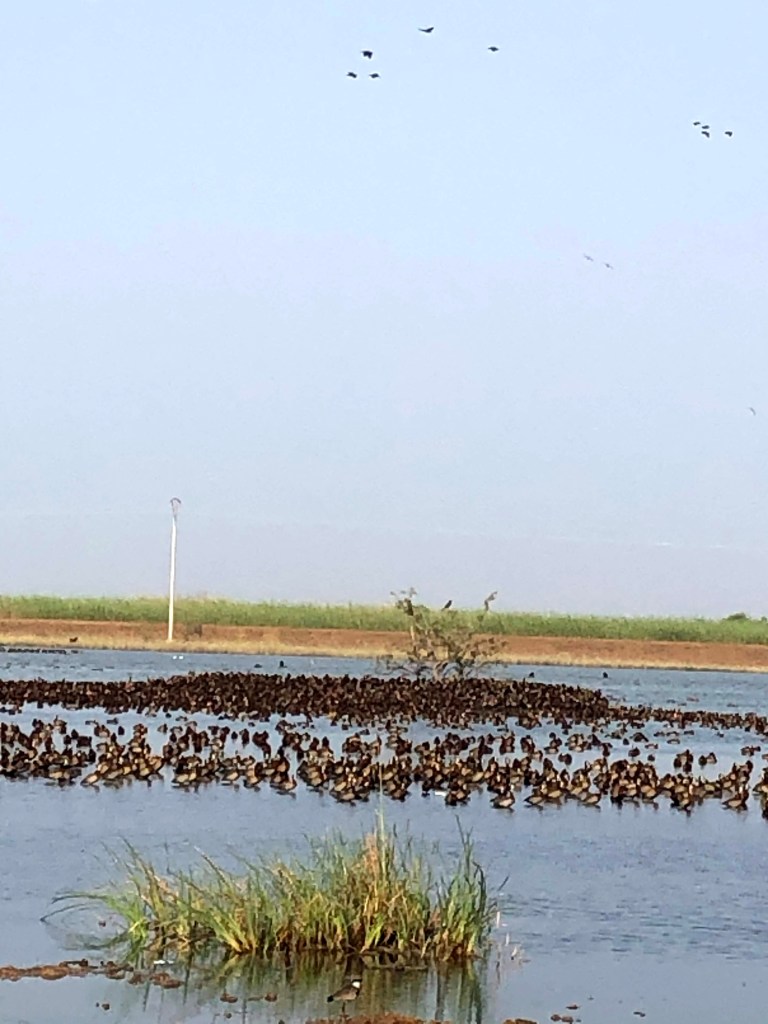
Increasingly it feels like we the Sahara Desert is closing in on us. Savanna plains are disappearing and sand dunes are becoming more frequent. There is a donkey roadkill on the side of the road and white backed vultures are feeding off the carcass. Feels surreal. After spending most of the day on the road the park emerges in our vision as a series of large open water plains as dusk begins to fall. Its beautiful. We know we are too late to enter the park, but we also know we will find a village to camp in, as is our custom. So we ramble down the dirt road towards the wetland area to arrive at a flock of literally hundreds of thousands of white faced (whistling) duck. Its draw droppingly spectacular. The duck rise from the wetland as we approach, forging a big black cloud of whistling birds, circling above us to find a new space to settle. The sky goes dark as the birds circle in chaotic, loud whistling, unison. We cannot believe what we are seeing and hearing. And we haven’t even entered the park yet!
We search and find a village alongside the wetland. It has a diagram of pelicans and herons drawn into the wall of the huts. Some birders have been here before. Good sign. We approach the patron as dusk sets in and ask about the park and whether we can camp here. He speaks French only and ours is just a bunch of broken phrases as presented by google translate. But its enough. Enough to get what he is saying. And he is saying the park closed today because of the virus. We are welcome to stay but we cannot enter the park. Not tomorrow or at any time for the foreseeable future.
Here we are at our campsite alongside Djoudji National Bird Sanctuary with its flocks of white faced duck:

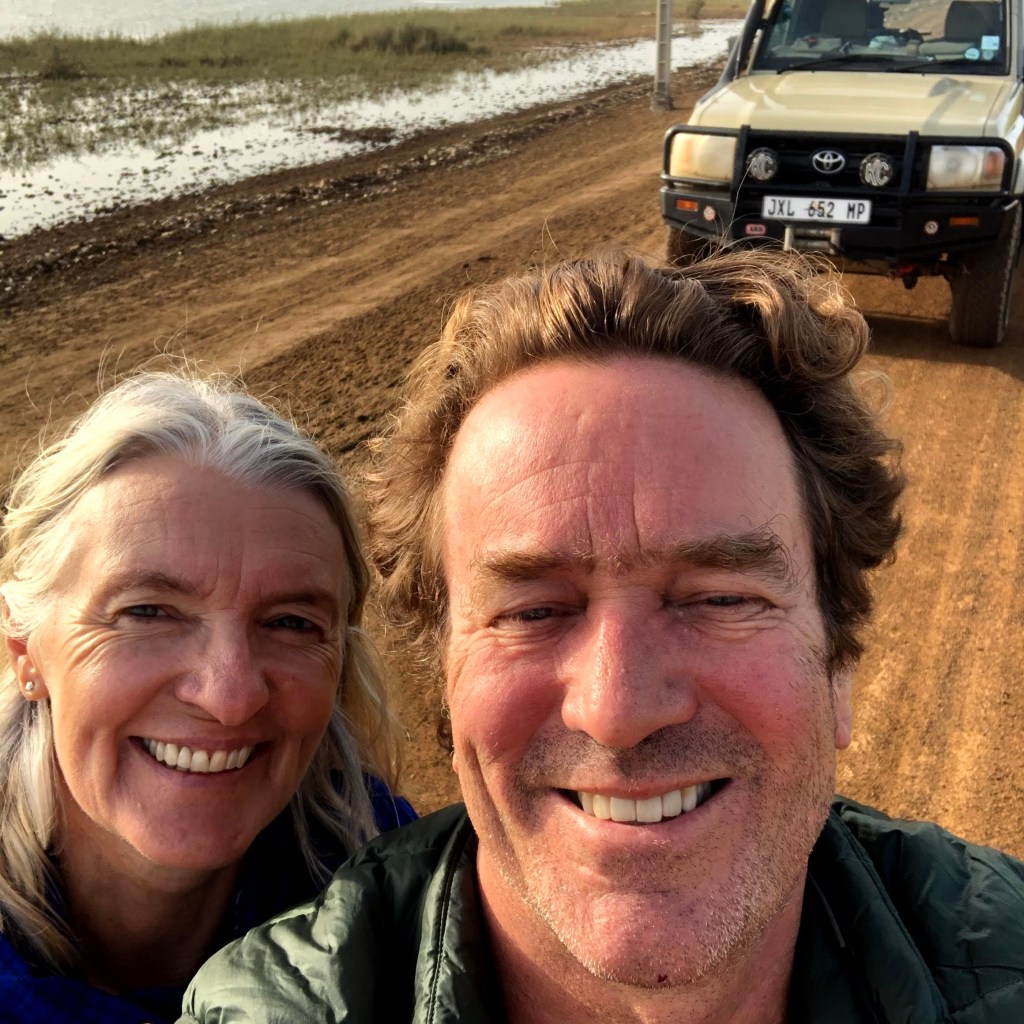
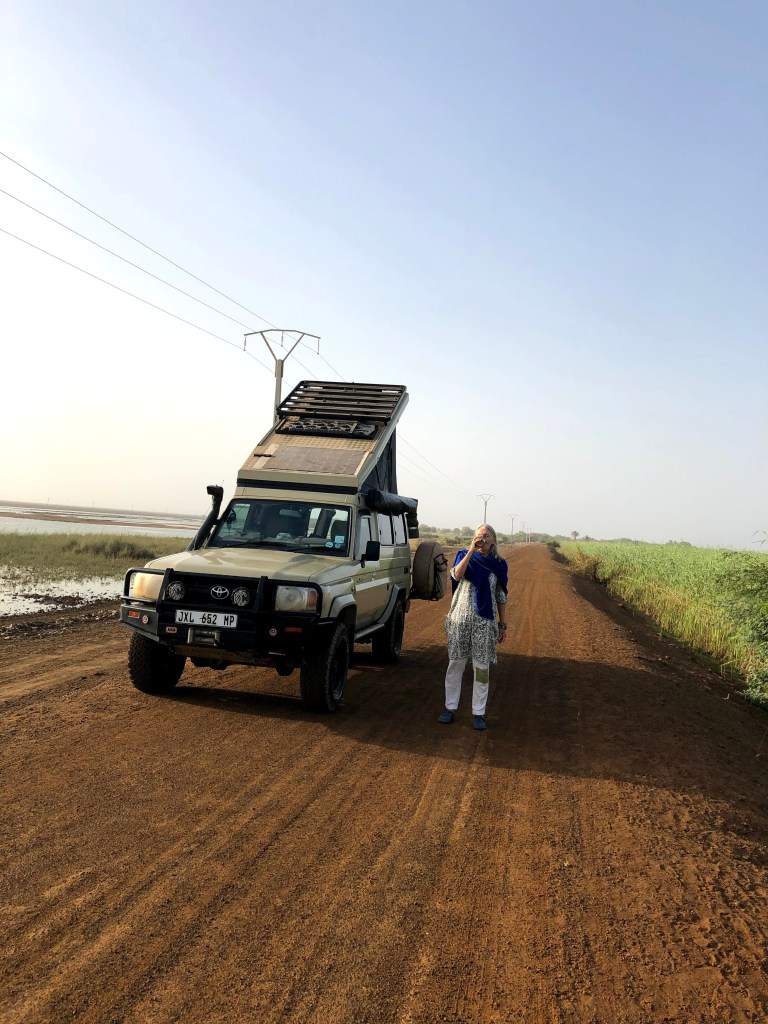
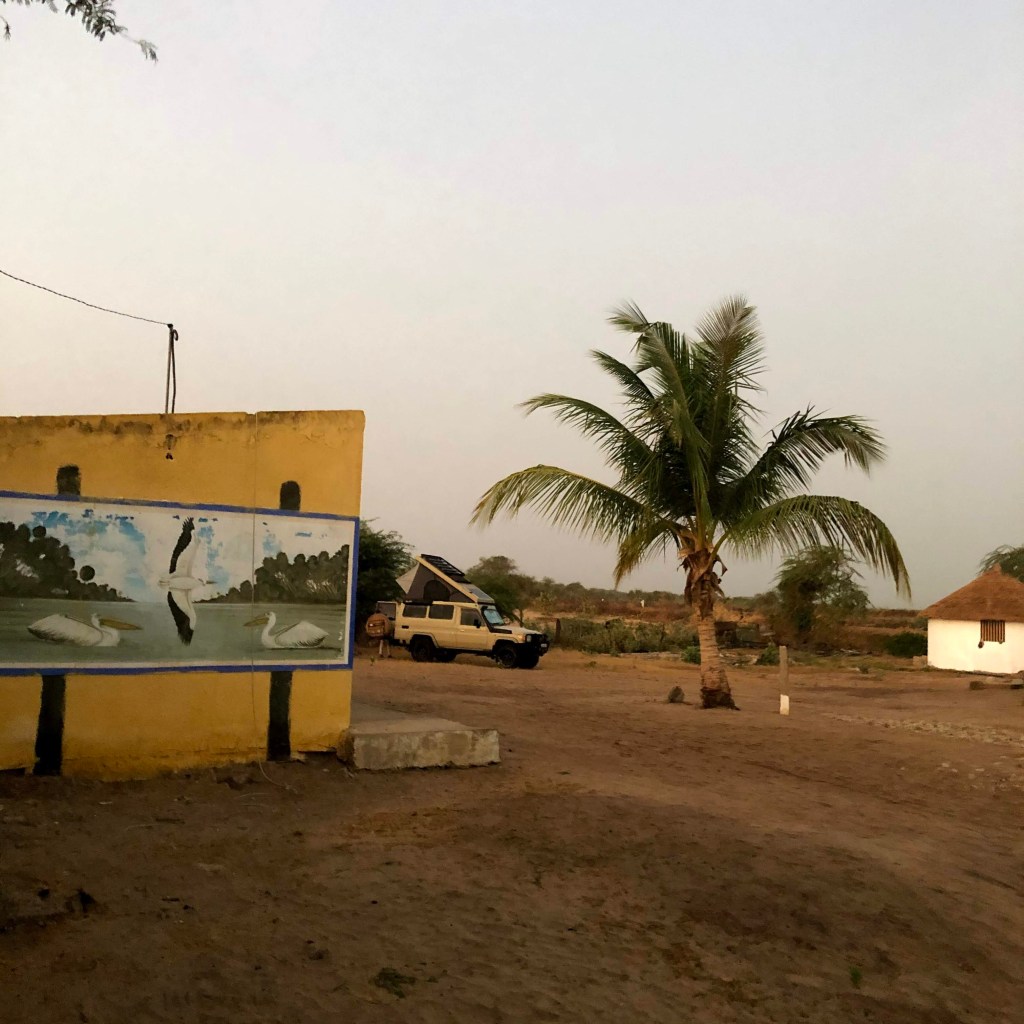
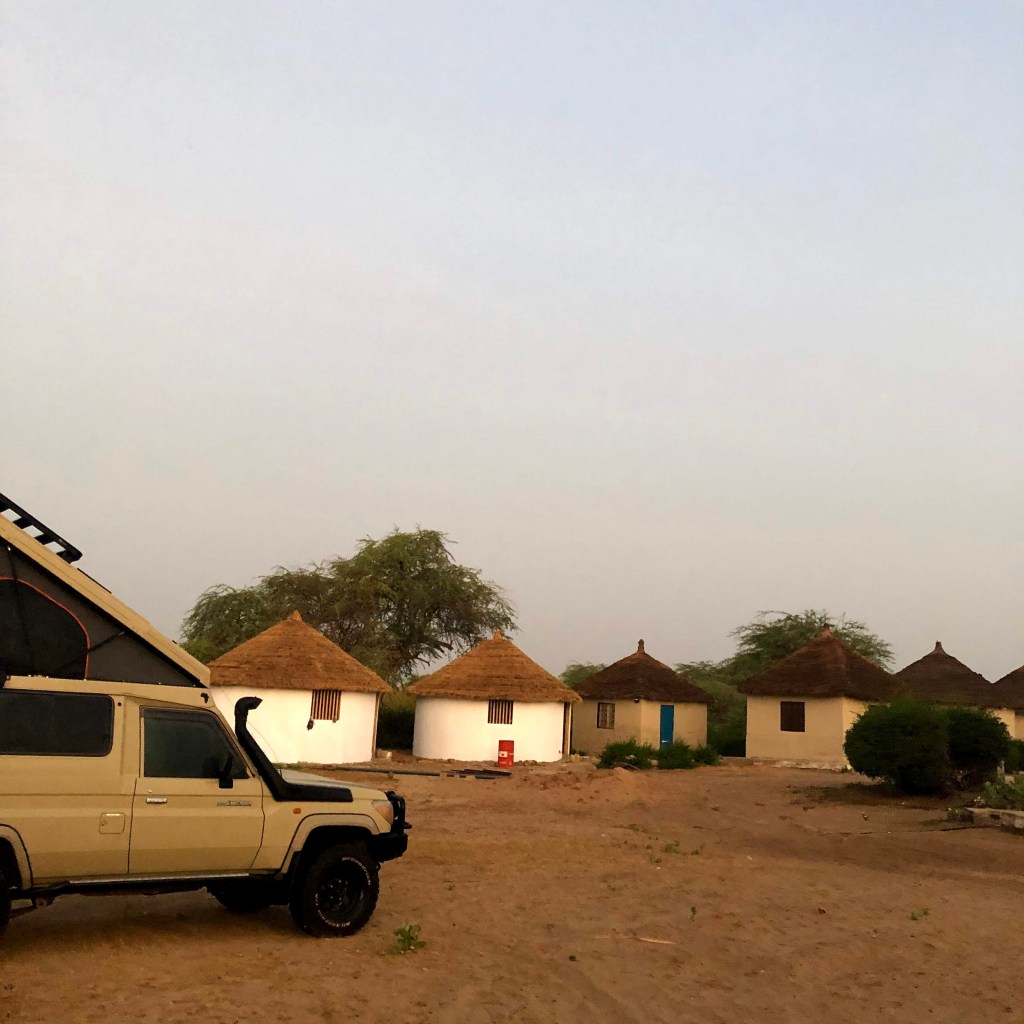
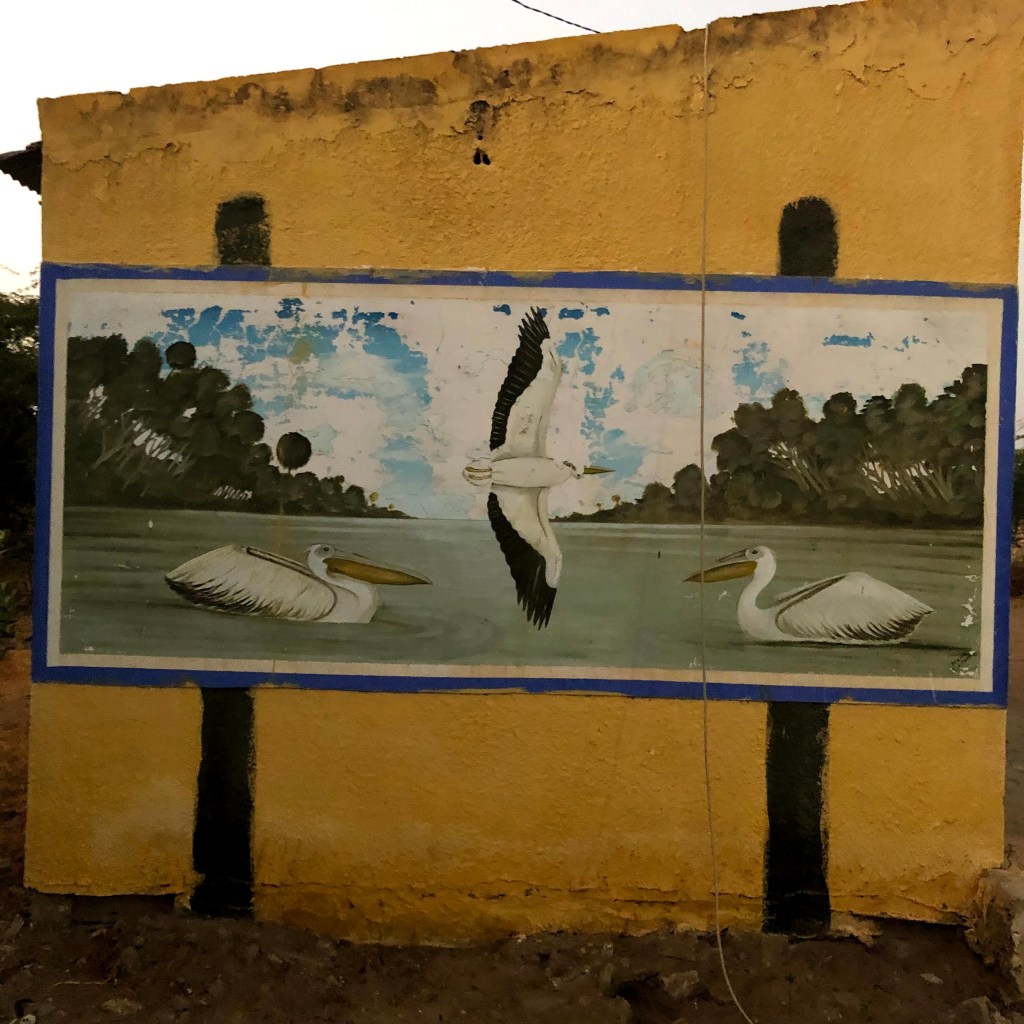


My heart literally sinks deep into my feet somewhere. From flocks of whistling duck elation we have gone into a sense of deep despair and low level fear of the unknown. This is starting to look very serious. Best I check if the border is even open. I construct a broken French message from google translate and, for the first time in the trip, I message it to the number of a Mauritanian-Moroccan border fixer I had picked up from other overlanders heading south. I have one question: is the southern Mauritanian and northern Moroccan borders still open?
I’m thinking if we can make a dash across Mauritania and into Morocco before the borders close we will find our piece of heaven in the olive grove with ponies outside Marrakesh. I wait for a reply and magically it arrives in an instant. All in French of course. I take the French message over to our host for an interpretation. He reads it and talks in French whilst gesticulating wildly. He is crossing his arms definitively. Seems to be saying everything is closed. No through traffic. All land borders are closed. We cannot believe what we are hearing. We double check the message on google translate. and sure enough the fixer is saying that the southern and northern land borders of Mauritania are closed. We drink a beer by the pond beside the hut and try to relax. Let the news sink in and just go to bed early. We know we will have to leave in the morning. We will have to head south. But not before standing amongst those flocks of whistling white-faced duck once more. We need that last goodbye.
We are speechless driving south. We cruise slowly. Not sure why but it seems that not that we know we are stranded there is no need to rush. Our future is uncertain. Let’s just live in the present and enjoy, I think to myself. Starting with the port city of Saint Louis, which we had bypassed on the way north in our haste to get close to the border. Let’s go there. Explore a little. Try to decide what to do. Take this one step at a time. Something will transpire. It always does.
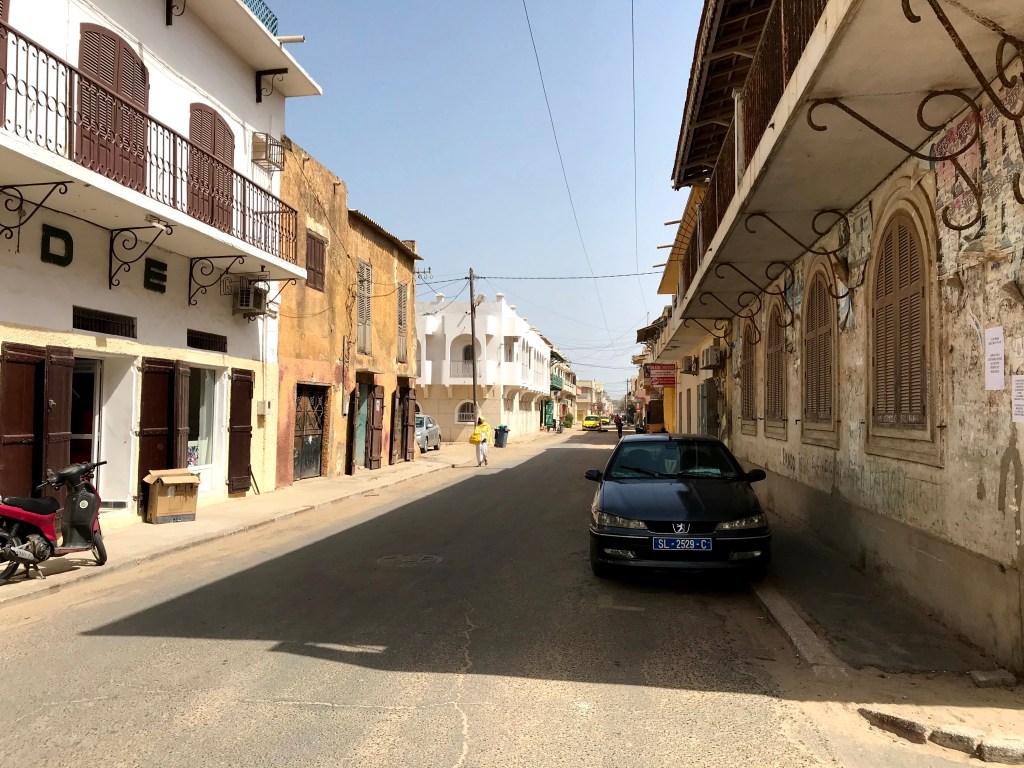
We roll into the fishing village type town of Saint Louis. It’s built on an estuary and it’s bustling with fishermen in their dhows and a local life of street trading. The old town sits on the peninsula which is linked to the mainland city area by a huge cast steel bridge, built by Eiffel of the Eiffel tower fame. The bridge links the old and the new and it’s simply stunning. Maybe it’s our semi shell shocked condition, but everything looks quaintly illuminated. It shines with warmth and tranquillity. It feels to our foreign eyes like its works with a certain harmony one associates with beehive activity. It’s got that quaint vibe of old French town elegance that comes with its french architecture, narrow and cobbled streets, brightly coloured bougainvillea’s falling over ancient, cracked walls. Artists, food peddlers and tradesmen are selling their wares alongside every street of the old town. And there are frescos on the walls of buildings with childlike drawings of scenes from “The Little Prince” with Antoine de Saint-Exupéry name inscribed in honour of his story and the pictures. This is the town:
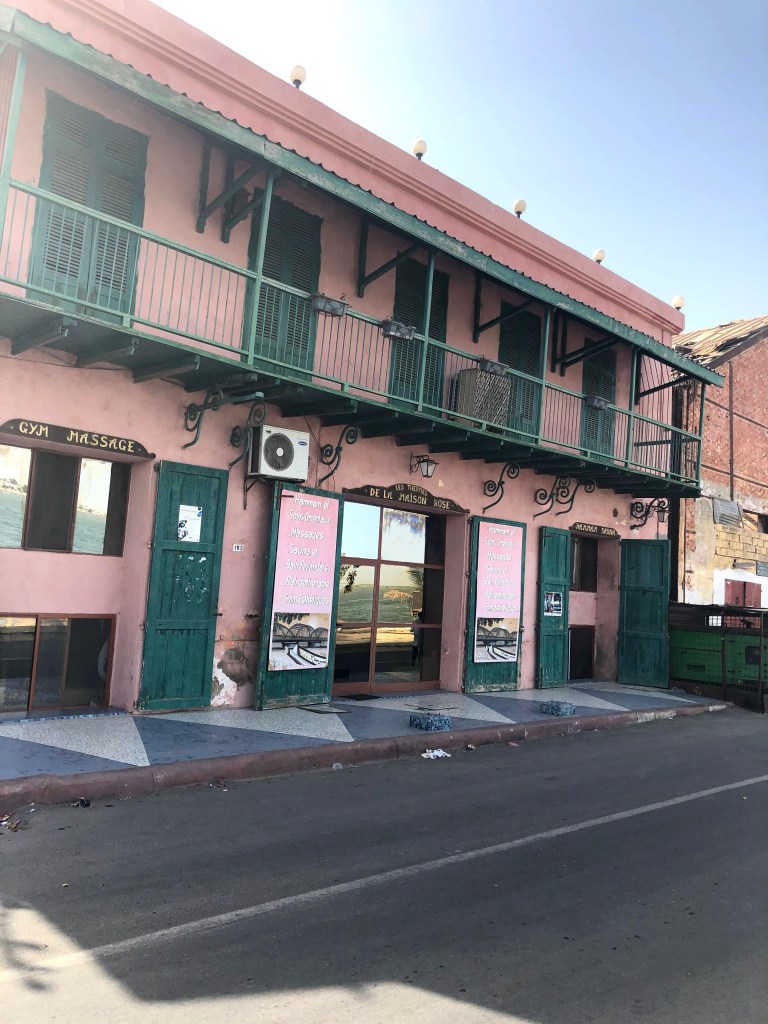
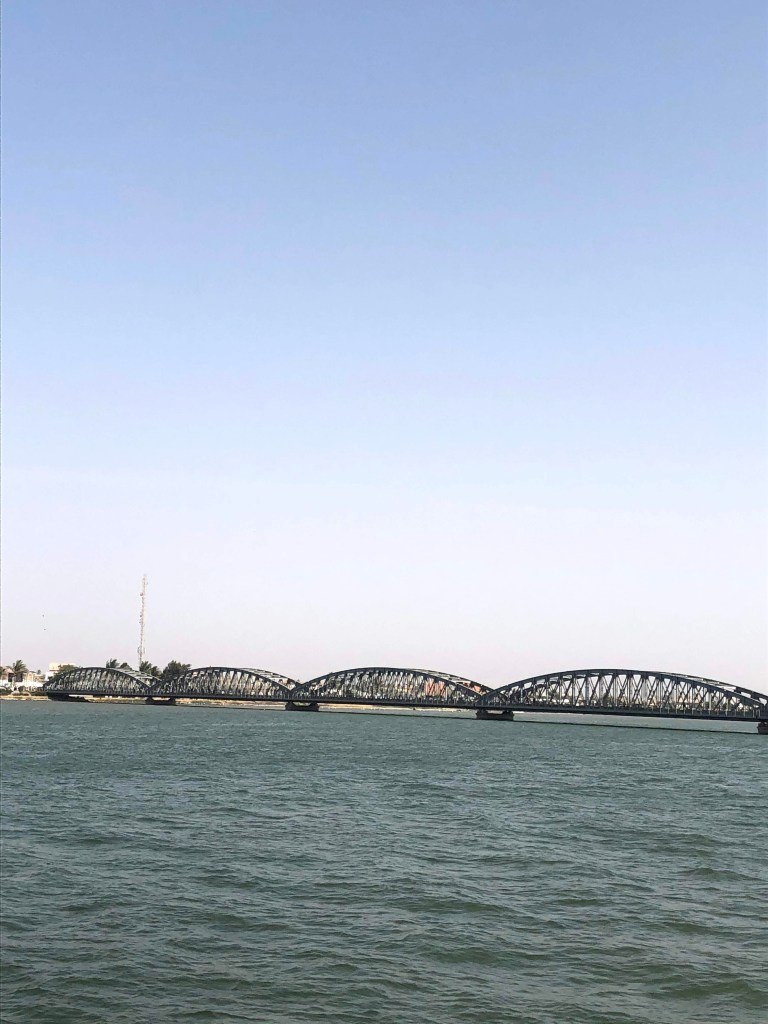
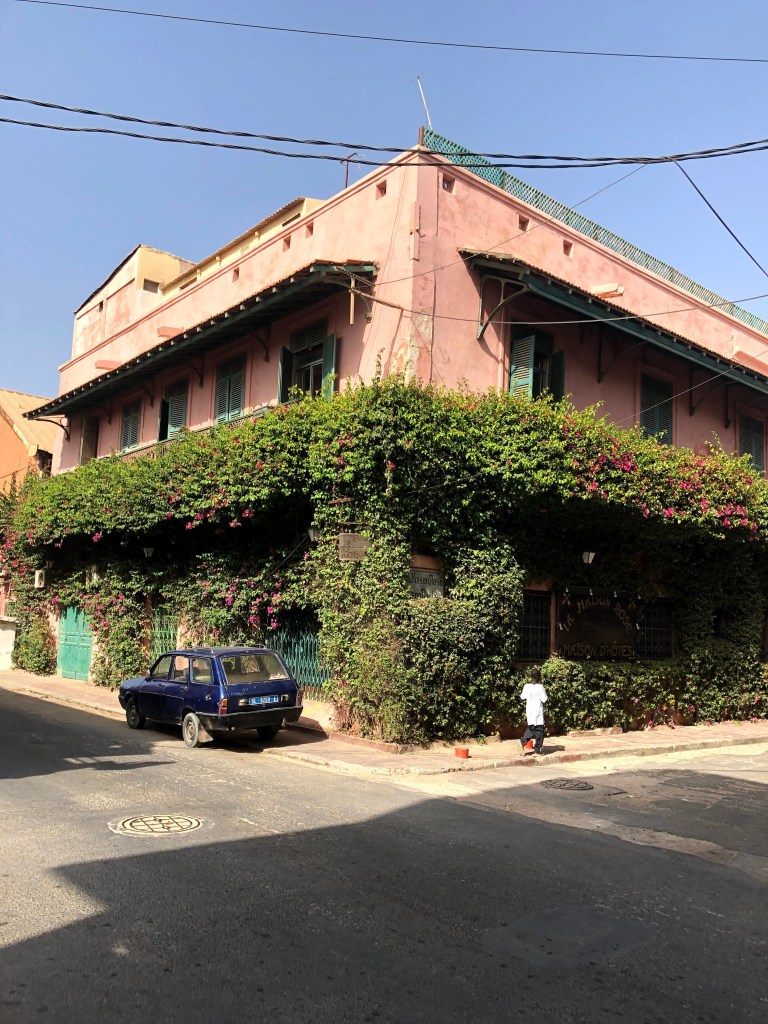
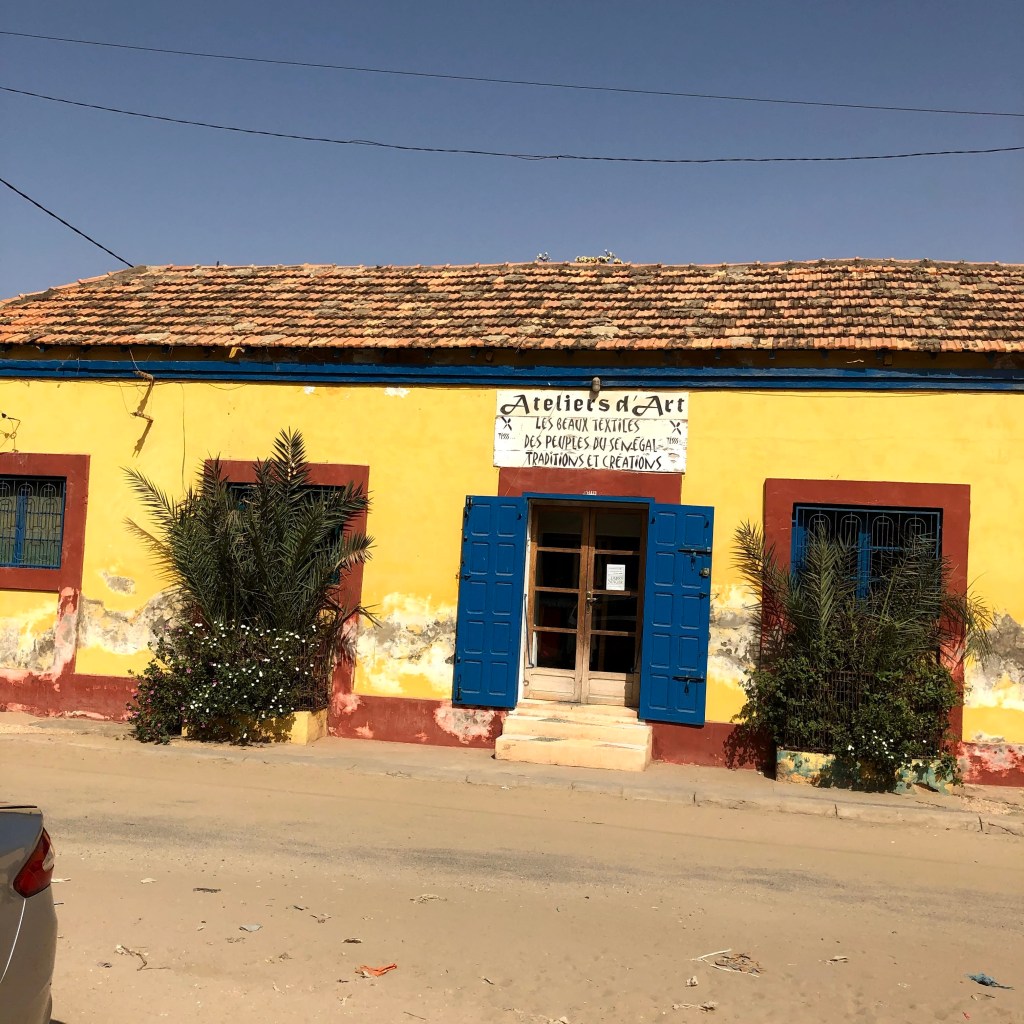
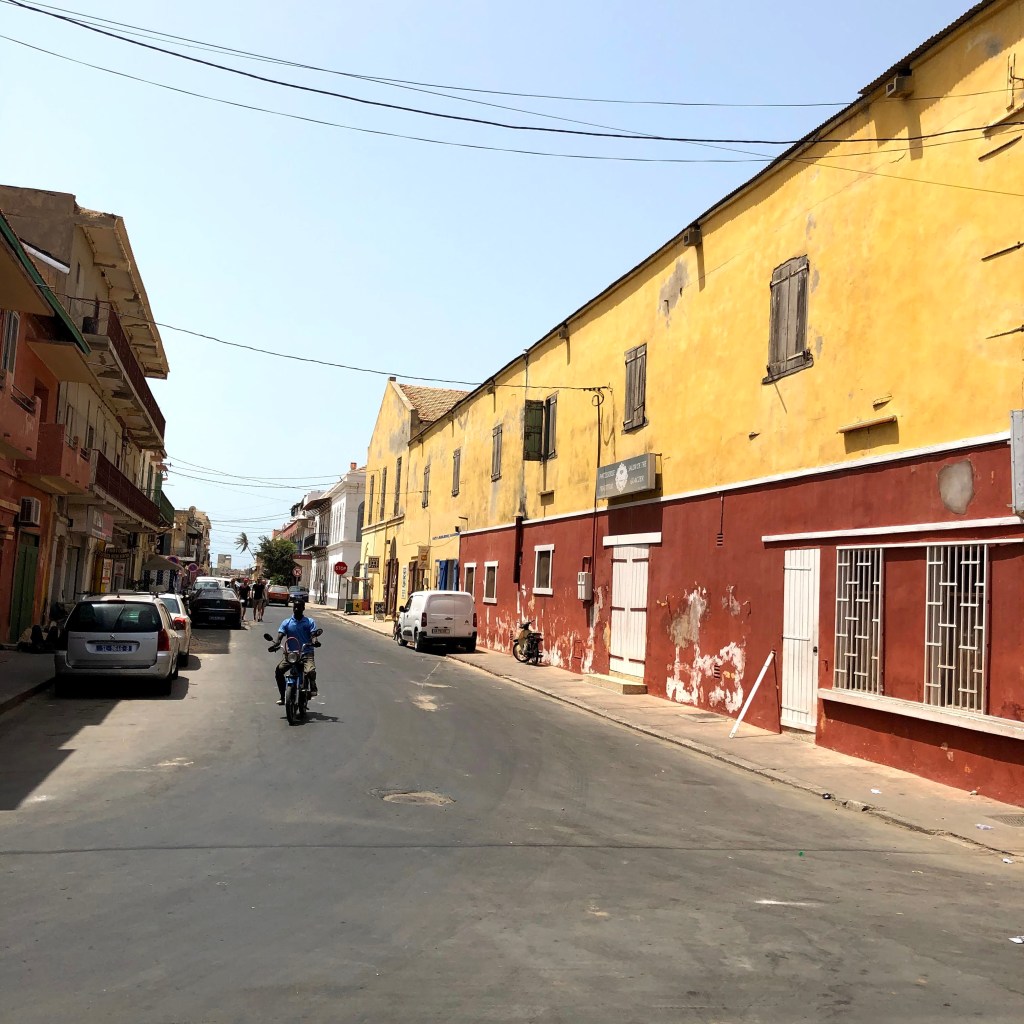
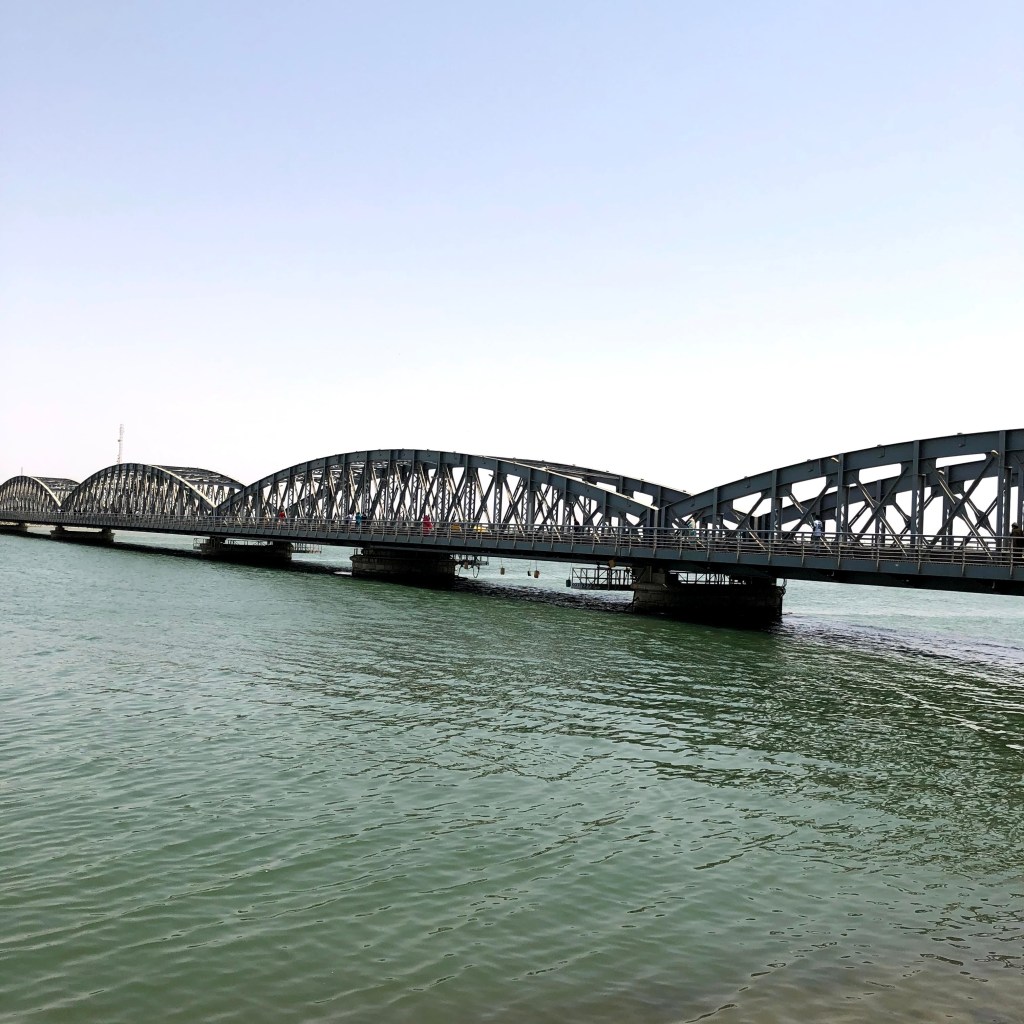
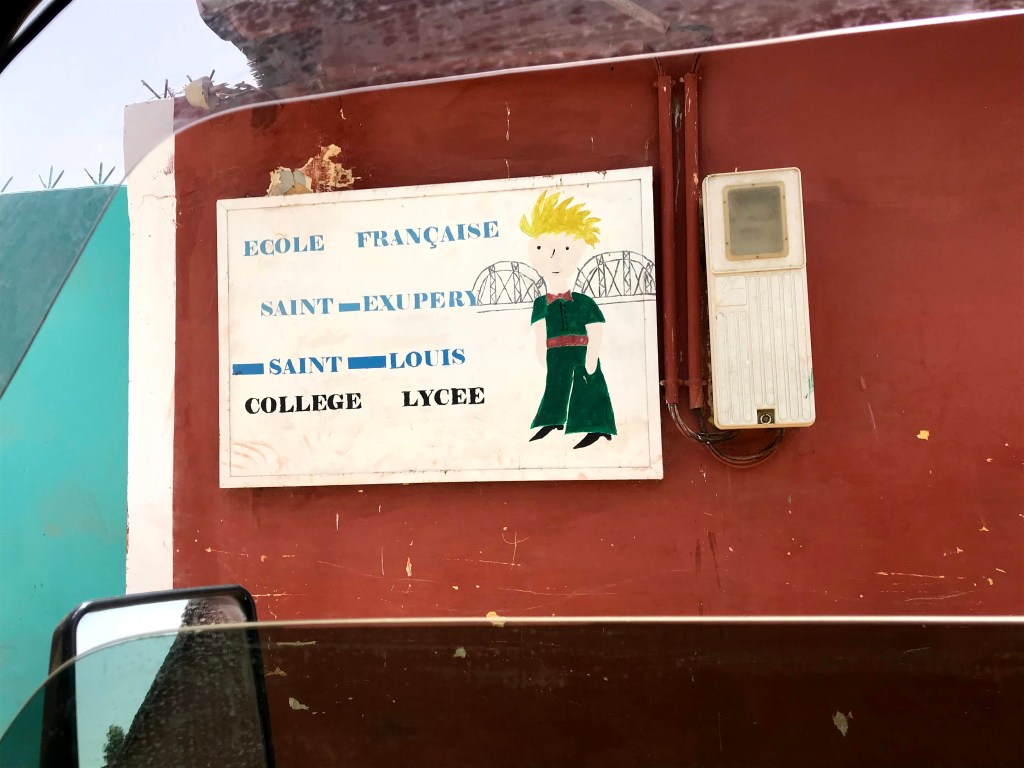
We wonder aimlessly around and land inside a beautiful shop that sells woven Senegalese fabrics to the capitals of the world. They are works of art and sadly way beyond our budget range, but we wonder in and are encouraged by the short French proprietor to try everything on. He is being very kind and has us drinking shots of expresso and admiring the works in no time. He doesn’t speak a word of English but soon he got to understand our predicament and was instantly inviting us to stay in his maison. Without any other viable alternative we gratefully accepted and follow our little French man down the street around the corner into his maison.
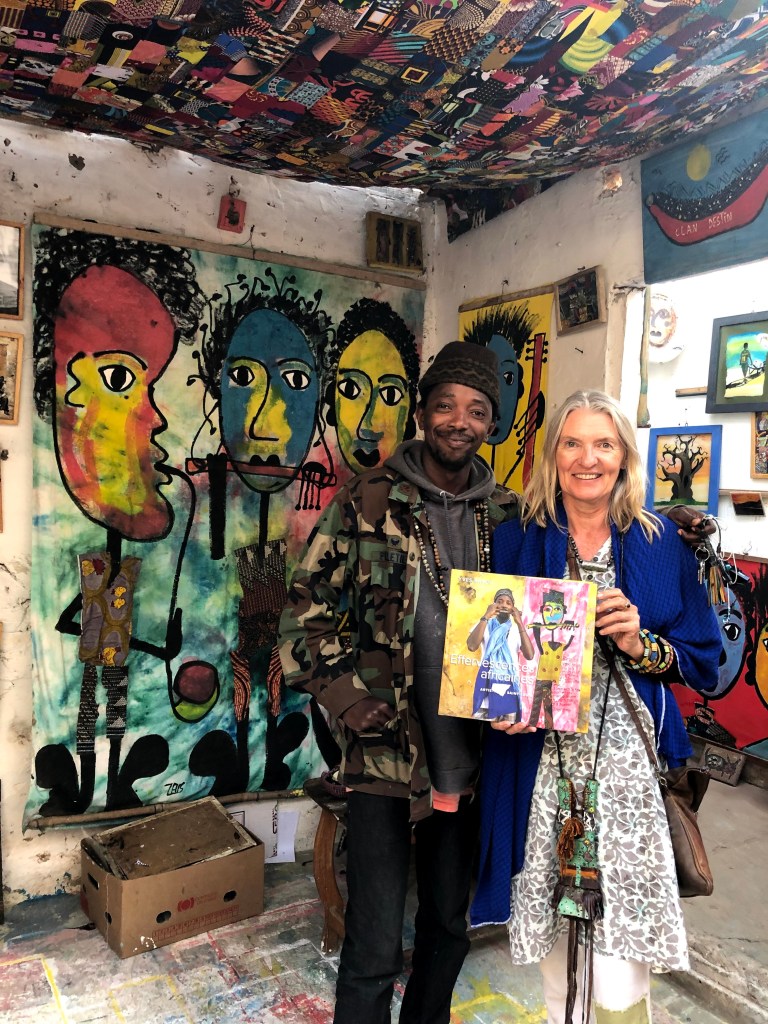
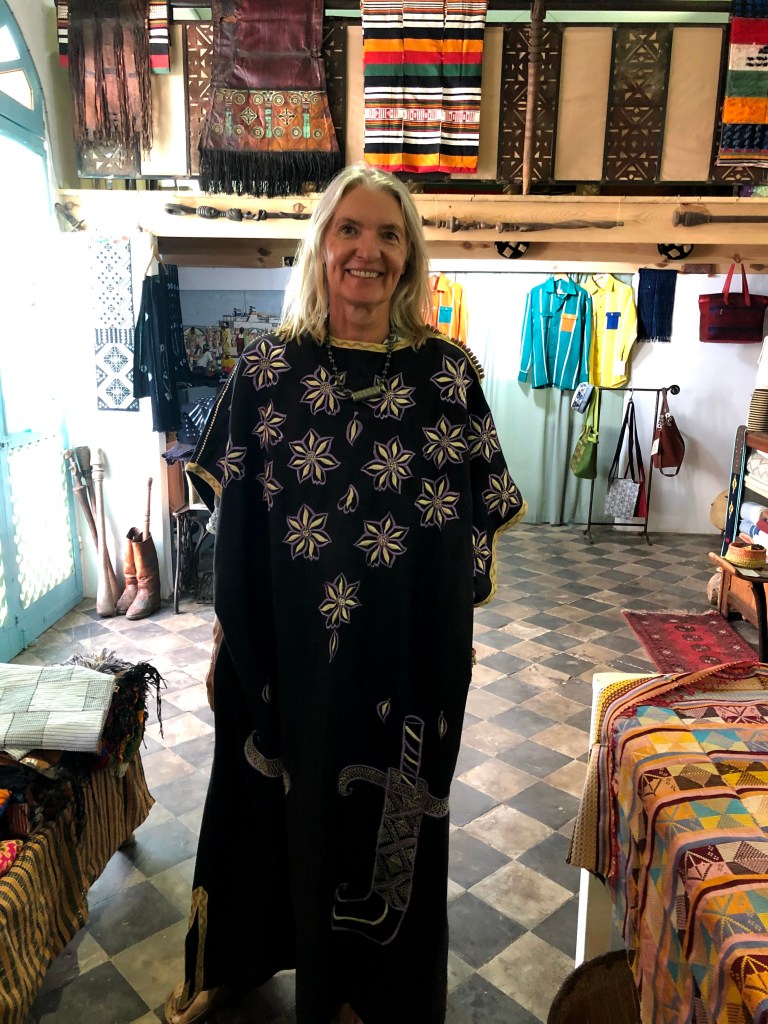
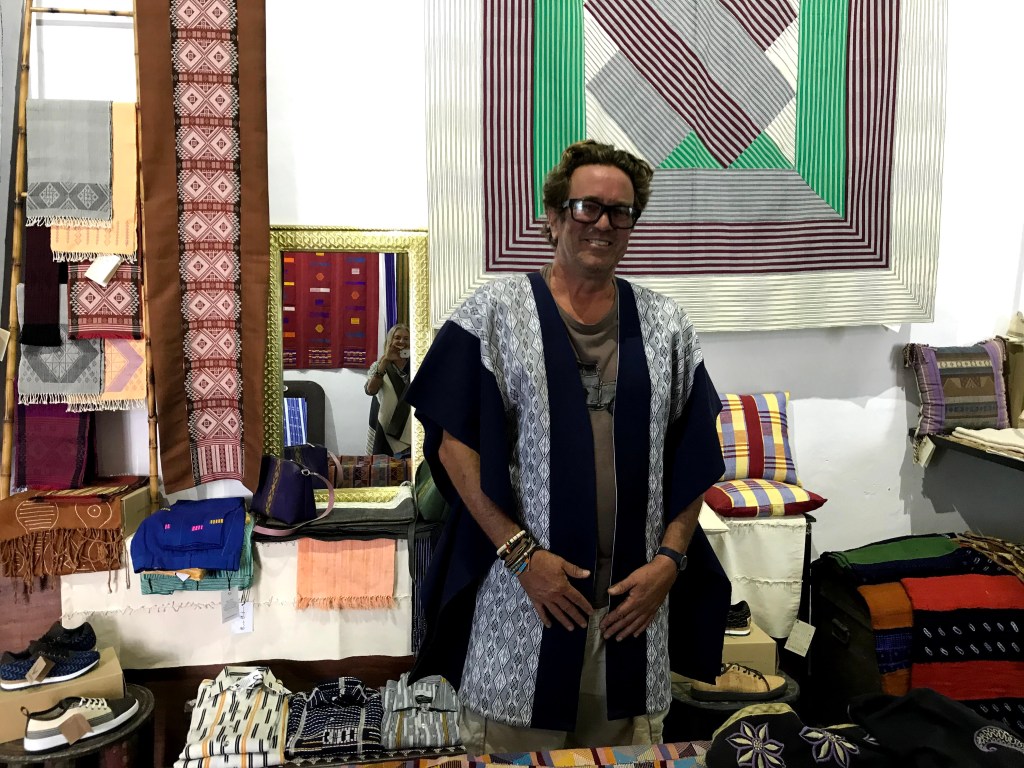
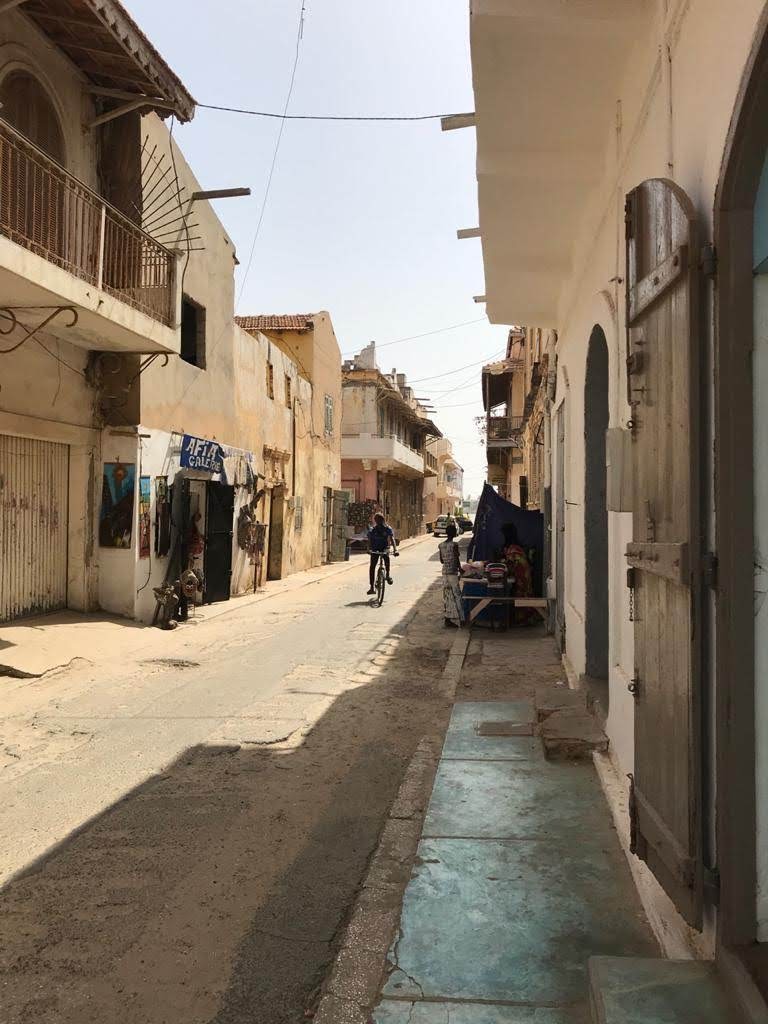
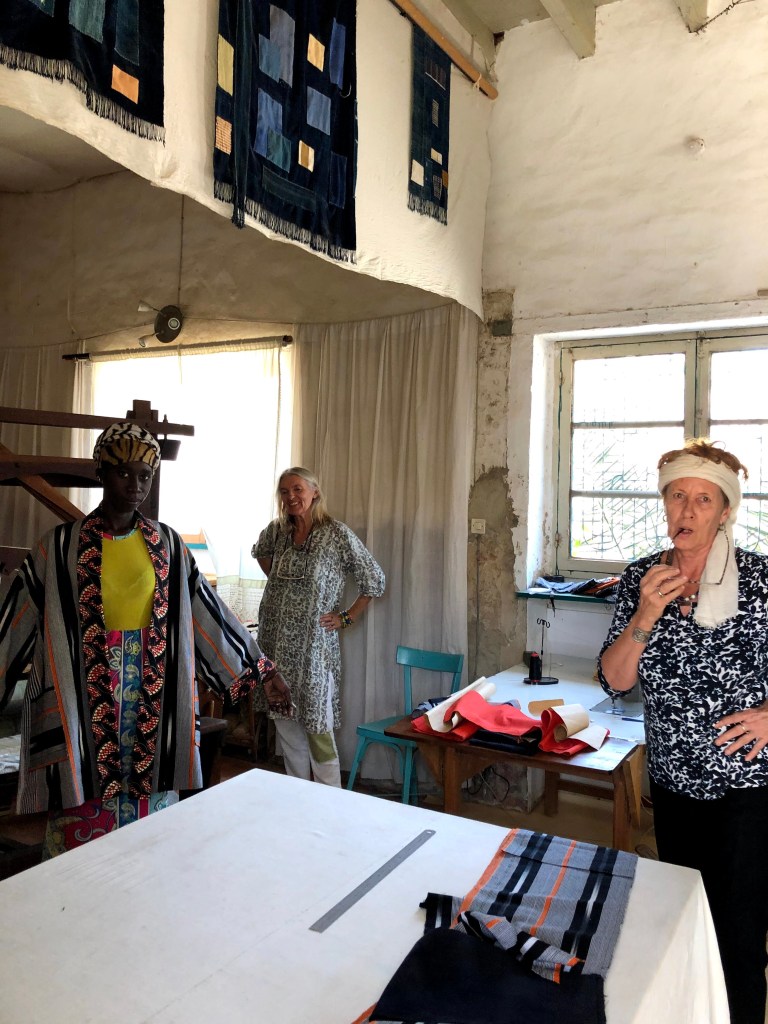
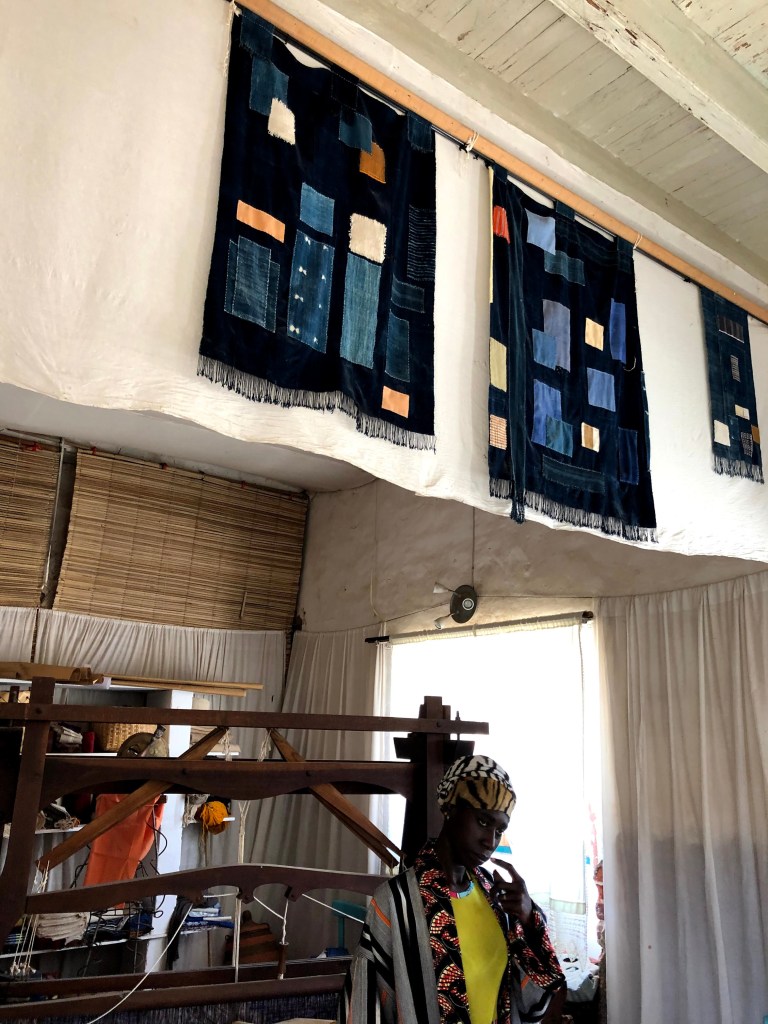
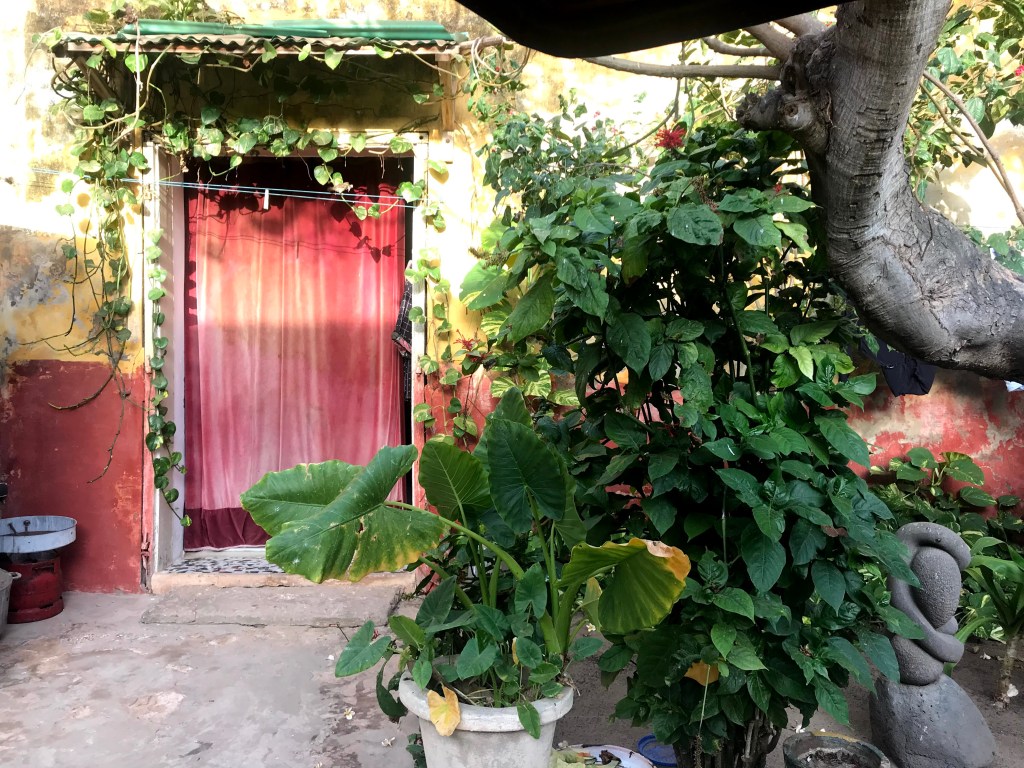
His maison is in fact an artist studio and home to his partner and her team of Senegalese weavers. She is from Paris and speaks good English and in no time she is showing us her weaving studio and our bedroom. Telling us to stay for as long as we want. “The rent gets cheaper the longer you stay, until we are friends and then it’s for free” we hear through her broken English. They are very kind and nice. We feel an immediate affinity. Their home is picture perfect. It reminds me of Frida Karlo’s home in Coyoacan, Mexico City. It has those same brightly coloured green, yellow and pink walls, with a small square yard from which the rooms look at each other across the little yard. There is a frangipanis tree in the yard with a kitten crawling around it. The smell of open fire and freshly cooked mackerel wafts across the yard. The room we are shown is cosy comfortable. It can just fit as bed into it. No more. And has its own tiny shower and toilet area with a toilet seat! The whole casa imbues a calm, warm and inviting energy of a resolved people. Everyone and everything feels peaceful, from the owners to the quaint building layout with its well-worn gentleness.
It’s not what I imagined to be the olive orchard and pony farm just outside Marrakesh. But that dream is now firmly shut down after our French speak man host, who is Moroccan it turn out, shows us videos received from his Moroccan friends of a completely deserted and shut down Marrakesh market. The farm won’t happen. So I am thinking alternatives. We could stay here for as long as we need to I guess, imagining a month or two. Not sure about that. so many questions. Not sure what to do. Feeling a bit unhinged, we decide to go for a walk and get a feel of the immediate area by walking the streets again.
The masion looks like this:
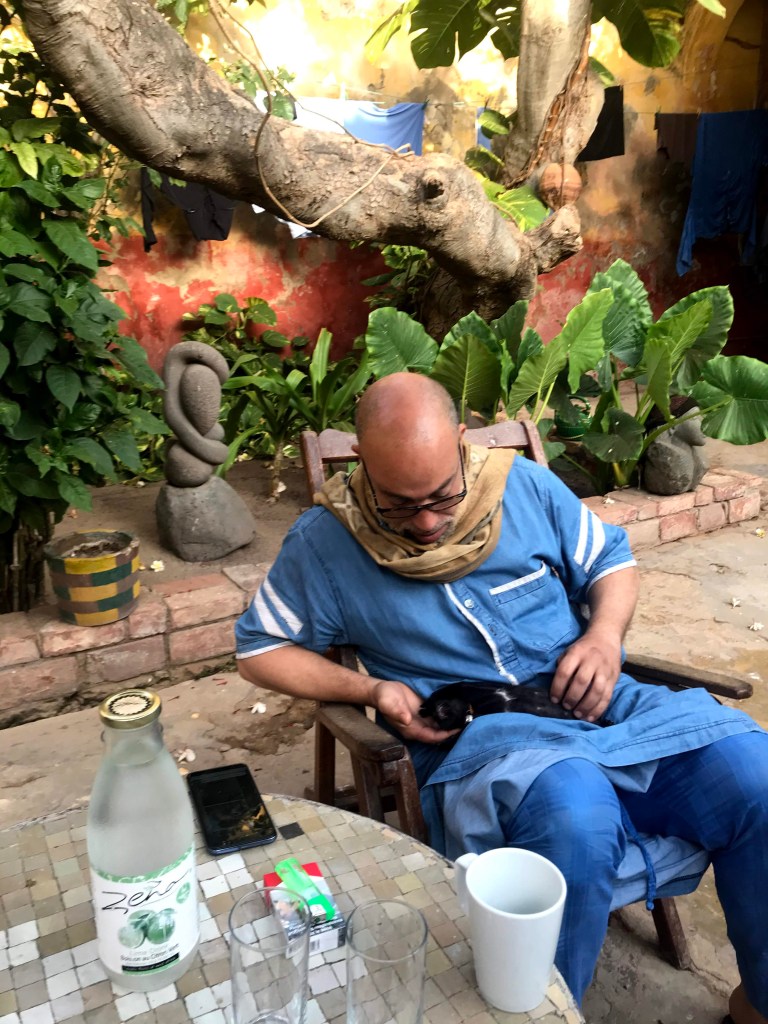

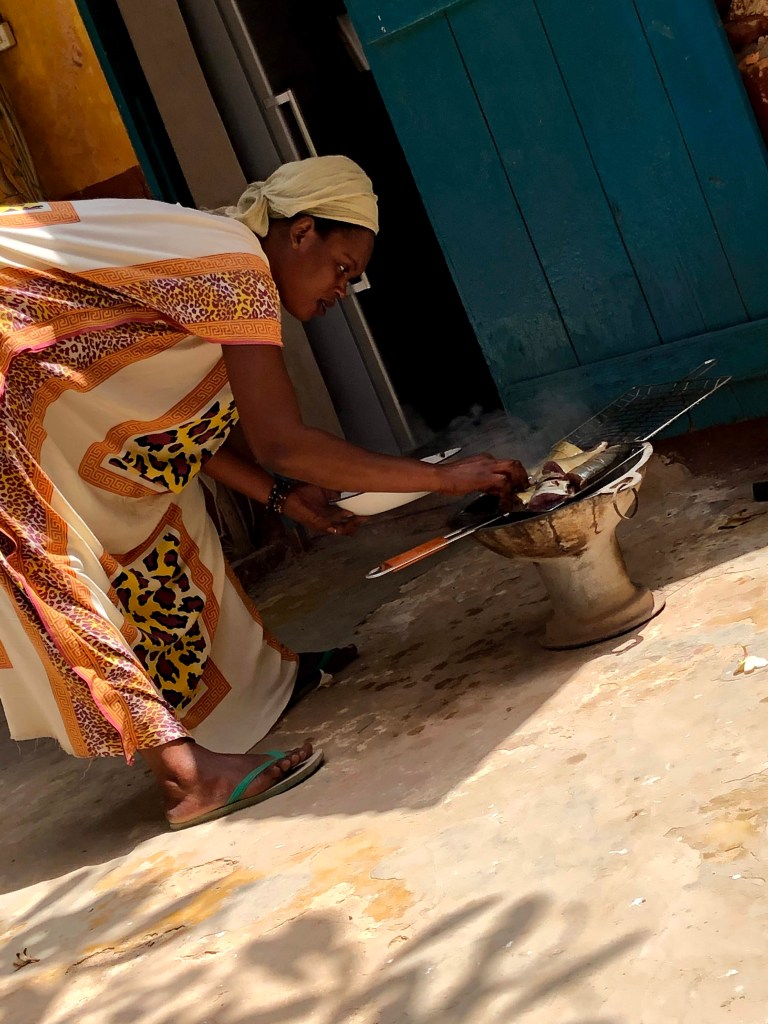
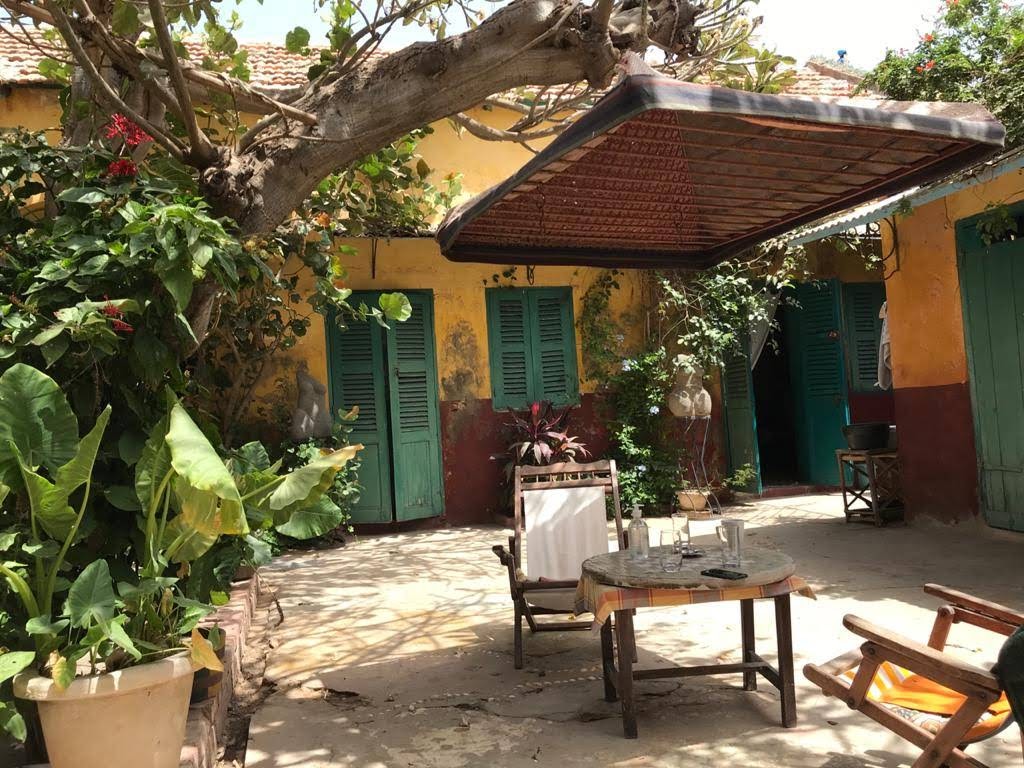
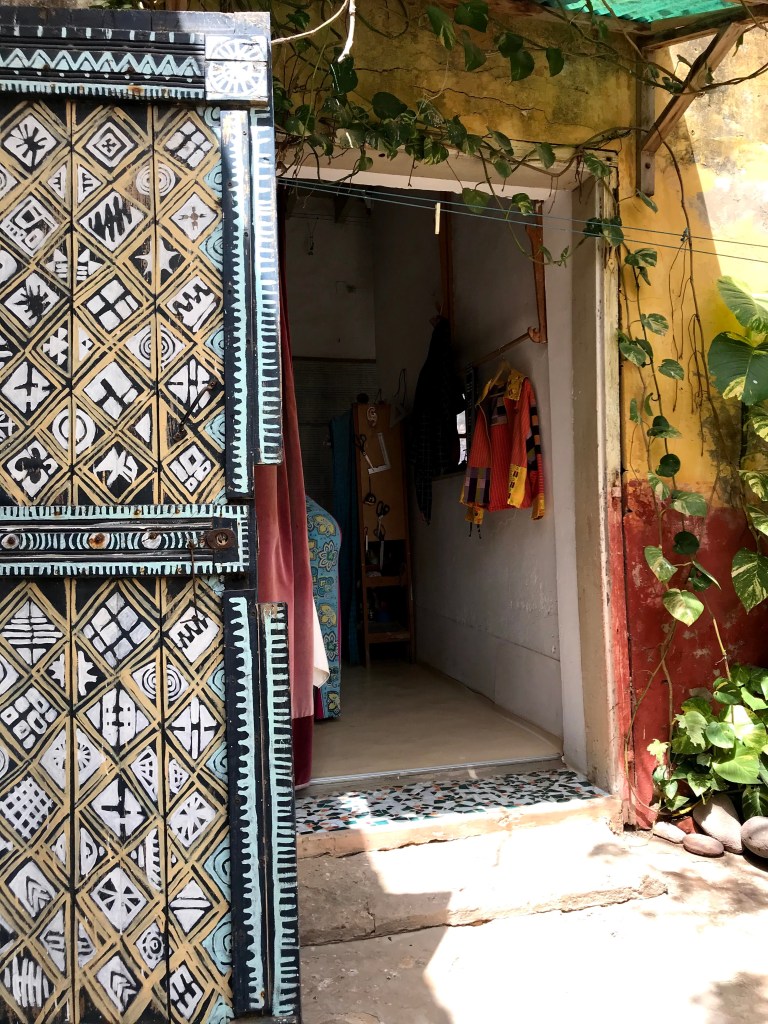
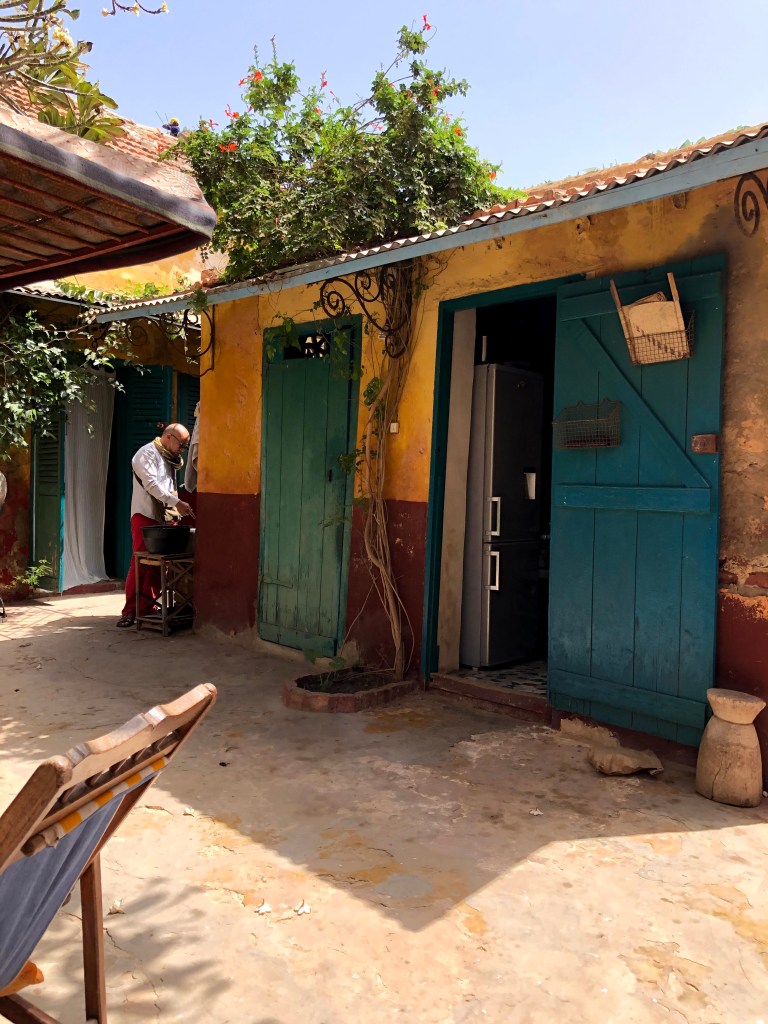
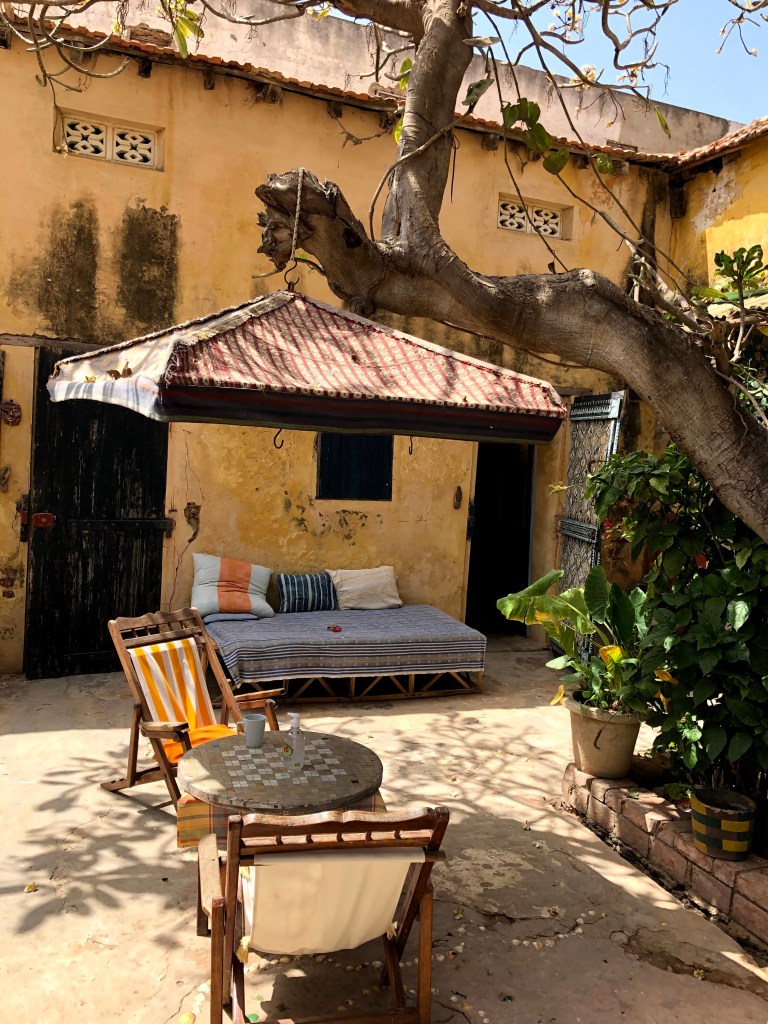
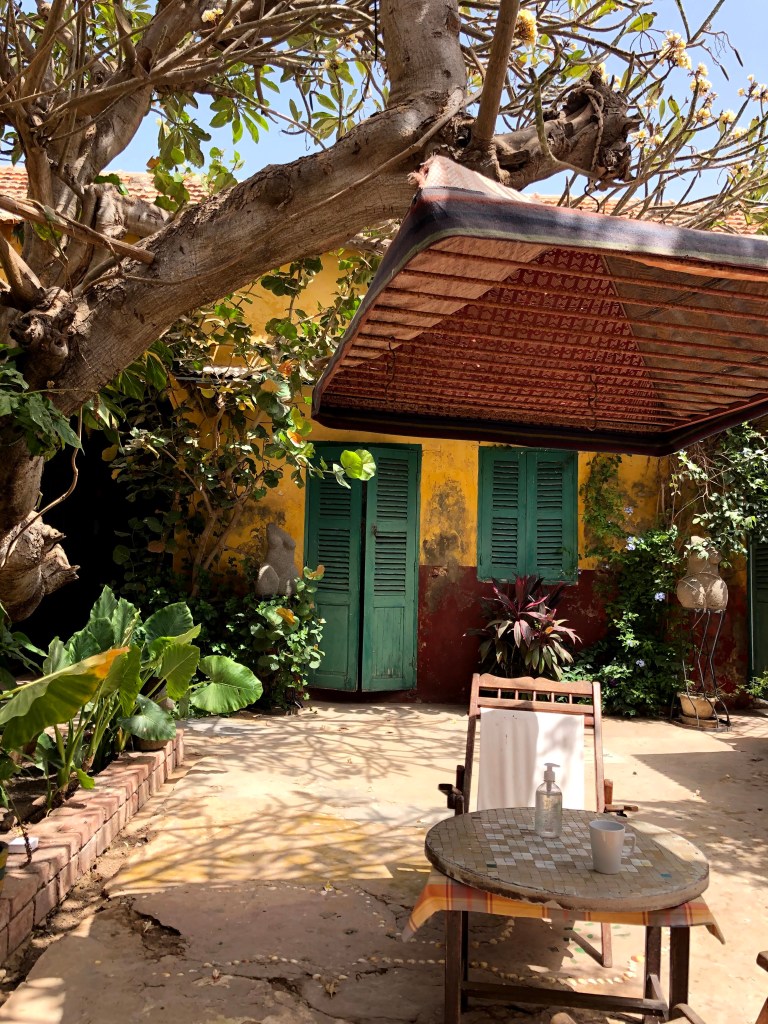
We visit countless tourist kiosk and artist stores and we meet the craftsmen and the artists. It’s all very warm and friendly and pleasant. One thing is missing: there are no tourists at all. So we start to engage the tradesmen in the stores to enquire about that anomaly. They all tell us that if we had arrived two days earlier you could not walk the streets for the crowds of mostly European tourists. It dawns on us like a deadweight that we are basically the last tourists standing in the quaint old town of Port St Louis.
There is a knawing feeling of insecurity in my gut. When I look at Lou I see her normal tranquil calmness and beauty being replaced with a concerned demeanour. It doesn’t suit her. We not really talking about what to do. But what to do is all that occupies our minds. We eat a light meal with our hosts and go to bed early, needing to be alone and get on the Wifi. We have not really committed either way. We don’t know if we are to stay or go. We need time out to really talk and think through our options.
Miraculously I have banked one exit option. Facebook delivered a message that a certain Mr Phillip Steenkamp, a South African living on a small holding outside Dakar, could possibly help us by giving us some ground to park our Troopy on, if we have to evacuate Senegal. I give him a call and he is everything one hopes for in crisis mode. His deep Afrikaans accent is dripping with trustworthiness and reassurance when he says to me: “Gavin, I will care for your Troopy” and sends me his location pin. I know instantly this is authentic and completely reliable. And I am greatly relieved to have Phillips’s small holding as an option to drop the car if we are to make a run for the airport.
But I am still not yet settled on whether to make a run or not. I am still struggling to let go of my dream overlanding experience. There are so many unknowns. This pandemic could blow over in a month. What is a pandemic anyway? What’s its character and how does it change how we live ? So many questions are swirling around my head as we crawl into bed. Still restless and uncertain of what to do. we try to sleep but it’s a miserable night. We fall in and out of a light sleep. At 3am we are wide awake and online. Lou is searching for shipping options and miraculously finds that Safmarine, now part of the Maersk Group, runs weekly cargo to Cape Town and other SA ports. We decide to drop them an email and request a meeting for tomorrow to see if they can take our Troopy home. I need a face to face meeting to ship. We finally drift off thinking we will amble back to Dakar and either get to meet Safmarine to ship home or get to Phillip and drop the vehicle in his yard. Whatever. we are in destiny’s hands.
We reluctantly say farewell to our kind hosts in the morning. Theyt are still telling us to stay with them. kind folk. But we can’t. Not least because tha they had told us we would have to stay in the yard and they would feed us. Too dangerous to go outside as a European in the pandemic. . That felt odd. Everyone had been so kind to us. We would discover later what they meant.
We get on the road to Dakar. We do a google maps search and see that we must exit the south bound main road to Steenkamp’s small holding just north of Dakar. So we are thinking if we don’t hear from Safmarine by the time we reach the Steenkamp exit, we will just drive to Phillip and drop the car and try and get to the airport from there. Leave it to fate what option – store or ship – transpires.. What else can you do? Not much, except watch your inbox on your phone as you drive and nurse that small hope that Safmarine responds to your email.
It’s three hundred kms to Dakar from St Louis. That’s about 5hrs and maybe more depending on traffic and road conditions. Its a Thursday. Things will be busy. We were reassuring each other that there is nothing to be done but focus on getting there safely when a Safmarine email drops into my inbox literally 20kms from the exit turn to Phillips place. In a heartbeat we decide let’s prioritise Safmarine. Better to ship the vehicle than store it. Safmarine email says they can meet us at 3pm at their Dakar offices. So if we wanna meet we must be there by 3pm latest. We quickly calculate that it’s tight, but doable. Can’t waste time. We reason that if Safmarine option does not materialise for whatever reason, we can always still go to Phillips place, just the long way round via south of Dakar city. Makes sense. So we bypass the Phillip exit and head straight into Dakar.
We are focussed on getting to Safmarine office swiftly and safely. The GPS is working the space, counting kilometres. We can do it. At least that what the Garmin says. But this is unpredictable Africa. Nothing works out the way it’s meant to, though you never know how. And as our luck would have it, for the first time in six and half months of driving through west Africa we are pulled over by cops. We know we have done nothing wrong. We just don’t know what is being expected of us or what we might be accused of having transgressed. The officer is tall and dark. Like really, really, dark in complexion, almost blue. And he is spitting angry at me. I try to make the friendly handshake shake or brother hug and he repels away from me like a snake, spitting on the ground and cursing. He is visibly very angry and repulsed by the mere sight of us. He is writing out countless fines and telling us in French that we have to go to the police station to pay them immediately. He is deadly serious and refuses to explain what law we may have transgressed. Nothing. Its a hard space to negotiate.
I am getting desperate. We are outside the car and in the searingly hot midday sun. This road block is taking time, as it always does. But now we don’t have time if we are to get to Safmarine by 3pm. The temperature is rising around me and within me. He seems to be under the illusion that we are Europeans. Two pale skins driving a Landcruiser southbound: it makes sense, they must be European. But it’s not true. He clearly has a deep hatred for Europeans. He is treating us like scum, like vermin. So I get my SA ID card and show him the SA flag and my pic. And I show him my SA passport. And my Garmin route map on my phone which clearly shows that I have come from the south. I am pleading that I am not European, but South African, and just want to get to Dakar to fly home. Eventually he pauses. Something in his African heart resonates. I was never sure what. He takes me to his commanding officer who is parked under a large acacia umbrella tree, chilling in the shade. As they always are. The documents are again scrutinized by the commanding officer. My ID, my passport, my driver licence, my Garmin route map. I get the feeling they have never met someone from the south of our continent. No a word passes between us. Just pointing and hand signals. But it’s enough. In an instant the tickets are torn up by the commanding officer and we are free to go.
Relieved, we climb back into the Troopy and pull away. The behaviour we have just been subject to is so way outside the love and warmth and sense of personal security we have experienced for the previous six months, that we are shaken up and deeply disturbed. This is not the West Africa we know. We keep wondering why. What is really going on? Then the reality of how we are being perceived hits us in a big waky waky aha moment. We are white people driving south! We are driving an overlanding Landcruiser tourist machine. We must come from Europe. The virus has embedded itself in northern Italy and is spreading throughout the European union. We are European. We must be virus carriers! Makes perfect sense.
There is a new hostility in the air from ordinary folk on the street. Where there once was love and warm smiles there is now a distinct air of suspicion, distrust and simmering hostility. Children who would dance and laugh and play, now look at us in fear. People who would wave at us from the side of the road, and whom we once hugged in a warm greeting gesture, now look at us in disdain or randomly spit at us or on the ground to demonstrate that we are vermin. We are having our first ever experience of being the targets of a rising tide of xenophobia sweeping across West Africa against anything European or Asian. It’s an insane experience. Feels so senseless. So unreal. Yet very, very scary. Makes me think that this is what it like to be a victim of racism. Even though I have fought racism my whole life, I have never experienced it. Not until now. And it’s not nice. More hatred will follow. Though we didn’t know how much more or when it will hit.
We are heading south and our time now is very, very tight. Doesn’t look like we will make it. All eyes are on the road. Hearts thumping. A sick feeling inhabits the pit of my stomach. It’s a mixture of things. Fear for the xenophobia that lurks on the streets of this once warm and friendly land. Thoughts of “will we get out?” plunder the mind. “Will we get caught and locked away?” lurks there too. We try to focus on the road and just drive, eyes peeled for cops and any local authority. Trying to see them, before being seen. Trying to be unseen as we go. It’s a deeply fearful and unsettling time. I try to think positives, or just distance myself from the negative thoughts trying to colonise my mind. And just stay cool. And accepting of our fate. I tell myself that there is no need to panic. I regret for a moment not heeding the warnings of my son. Then I let that thought go to. No point. Bygones are bygones. Just stick to our plan. I tell myself no need to panic. Again and again. No need to panic. And that is how we roll. All the way to Safmarine office in central Dakar.
Miraculously we arrive just on 3pm. The office is still open. We tear inside and are relived to find it air conditioned. Its clean and cool. We could be in Sandton. Elegant Senegalese men and women, dressed in smart traditional attire. A calm and refined Senegalese women approaches us. We tell our story and she calmly says she can ship the Troopy to Cape Town no problem. She comes and goes from fron office to back office seemingly looking for paperwork. We say we can give her a deposit of $900 cash from our car (which was all the money we had) and we would pay the balance on collecting the car in Cape Town. She is happy with that. We are ecstatic. We can ship our Troopy home and fly out of Dakar. A massive tidal wave size sense of relief sweeps over us. All caution goes out the window. We can do this deal on a handshake. Give our lady the $900 cash and our vehicle. Leave. Trust the process. No paperwork necessary. Nothing. And that’s exactly what happened. And it felt and was completely right.
As we organising the logistics to give over our car, cash and carnet de passage to Safmarine, Lou is on the phone top book a flight home. She secures an Air Kenya flight to Nairobi and Johannesburg departing on Saturday night. Perfect !! Today is Thursday. We can have two nights in Dakar celebrating our overlanding trip across west Africa and calmly fly back home on Saturday. We just have to unpack critical goods from Troopy and deliver the car into the container at Safmarine and leave. We are feeling beyond elated.
I think to myself: “Love it when a plan comes together!” In my heart I am silently thanking the ancestors for caring for me. And then our Safmarine lady says there is a problem. She has just heard a rumour that the airport will close to all commercial flights on Friday at midnight. What? You not serious. My heart sinks and there is that heavy dead feeling again through my legs. And a very sick feeling in the pit of the stomach. She sees our anguish and says that she has a brother who is an official at the airport. She will find out from him if the rumour is true and email us in the morning. We are grateful. We decide to leave our booking as is. It’s our lifeline out of Senegal and back home again. Wait for her email. Maybe there is nothing in it. Let’s go and celebrate anyway.
We drive out of central Dakar looking for a hotel to sleep in. We decide to just doorstop any reasonable hotel we find on google maps. The sun is setting and the city is thick with commuters trying to find their way home. The xenophobia feeling is still in the air. It all feels alien and hostile for some reason. Not at all how it felt a week earlier when we were last here. We stop at hotel after hotel. Each has accommodation but “not for us”. No one will take any European. We are aliens in Africa. Truly. We keep driving upmarket from hotel to hotel, thinking surely a Radisson will take us. And we are right. We end up being accepted in a beyond budget hotel. But we are desperate. It is almost dark. We need to eat and settle. It’s been a very rough day.
After hotel check-in we find a restaurant with a view of the quaint looking Dakar Bay area. It’s so beautiful. We are feeling good. We have the car scheduled for shipment. We have flights booked for home. There is a low-level worry about the airport closing, but that is just a rumour. And we know how rumours come and go. So all good on balance. I order a large plate of prawns and chips. My absolute favourite. And a cold beer. Life could be worse. I am wallowing in our good fortune as Lou orders some not so nice vegetarian pizza of sorts. And we both sit in almost complete silence and stare at the view, listening to the Dakar night sounds, and just reflecting on all we have been through for the past six and half months on the road. It feels so right. Sad yes that we are abandoning ship. But so, so relieved that we and our vehicle can both get home. More so because this is not nice anymore with the xenophobia on the street. Not nice at all. Suddenly we really need the familiarity of home.
We sleep early and rise early. As we turn on our phones they are buzzing with messages. There are two that sink us. The first is from our Safmarine lady. She has spoken to her brother and the rumour is confirmed as fact. The Senegalese government will close the airport at midnight on Friday night. That tonight! It also means our Air Kenya flight scheduled for Saturday wont land. The second message was from the agent who secured our Air Kenya flight. Her message confirms our worst fears: the flight for Saturday night has indeed been cancelled. We are back to square one. No road out of Senegal and airports are closing at midnight tonight. It’s 7am and we have just today to find a solution. Lou is onto it immediately. Imploring our agent to find another flight. Any flight to anywhere to get out. She is on it. We wait. Try to have breakfast and a coffee.
We just wrapping up our breakfast bite and we are blessed with the best news ever. Our agent has got us onto an Air Ethiopia flight to Addis and another from Addis to Johannesburg. Thanks to Air Ethiopia who took a decision to continue to fly to “where the passengers needed to go” during the pandemic until airports were closed to them. The Air Ethiopia flight leaves Dakar 15 minutes before the airport closure at midnight. But she says, “we need to get to airport immediately. You never know what will happen”. We don’t need any convincing. We fly down our hotel stairs and start unpacking the Troopy like two people possessed. Frantically finding and removing all electronic goods and stuffing some clothes into the one bag we were carrying. Everything else we just left. No way to get it out. We decide we will take our chances with the legendary pilfering on shipping lines. Our priority is to save ourselves and our Troopy and get us out. All remaining food is donated to the security guys at the hotel. And we have just one bag and leave to go back to Safmarine.
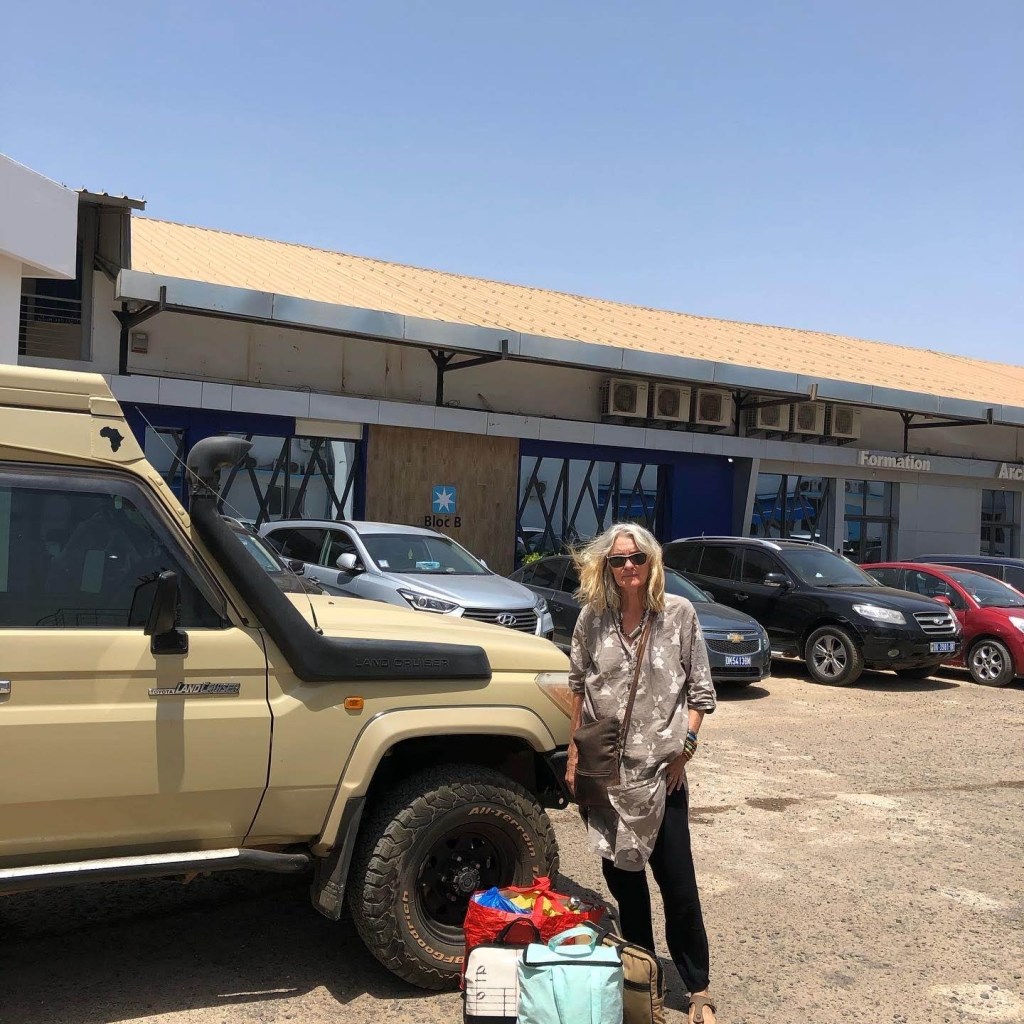
We are moving at speed. No time for administrative formalities at Safmarine. We trust these people. We tell them they must complete the carnet de passage formalities, clear customs and load our vehicle into a container for us. We don’t have time to do any of that. We must get to the airport and check in and wait. They fully understand. Assuring us all the necessary paperwork will be done. They book us a taxi and shepherd us into its back seat with smiles and hugs and goodbyes. And we are on our way to the airport. Safmarine with Marie Pinto who cared for us and Dakar airport exit:
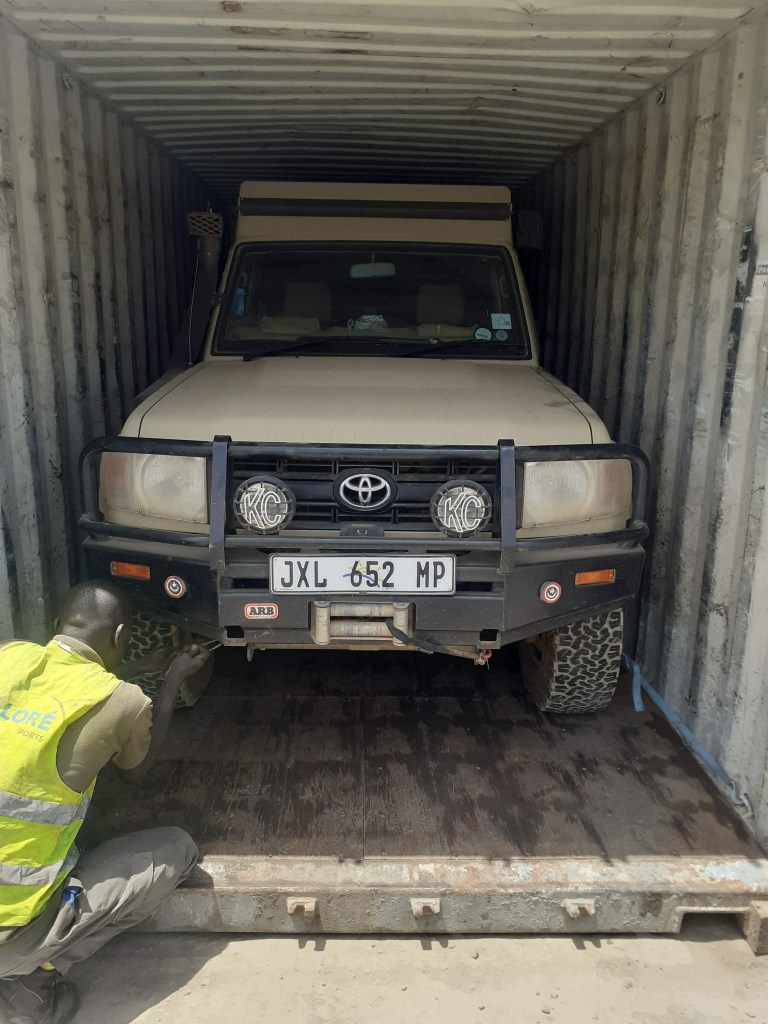
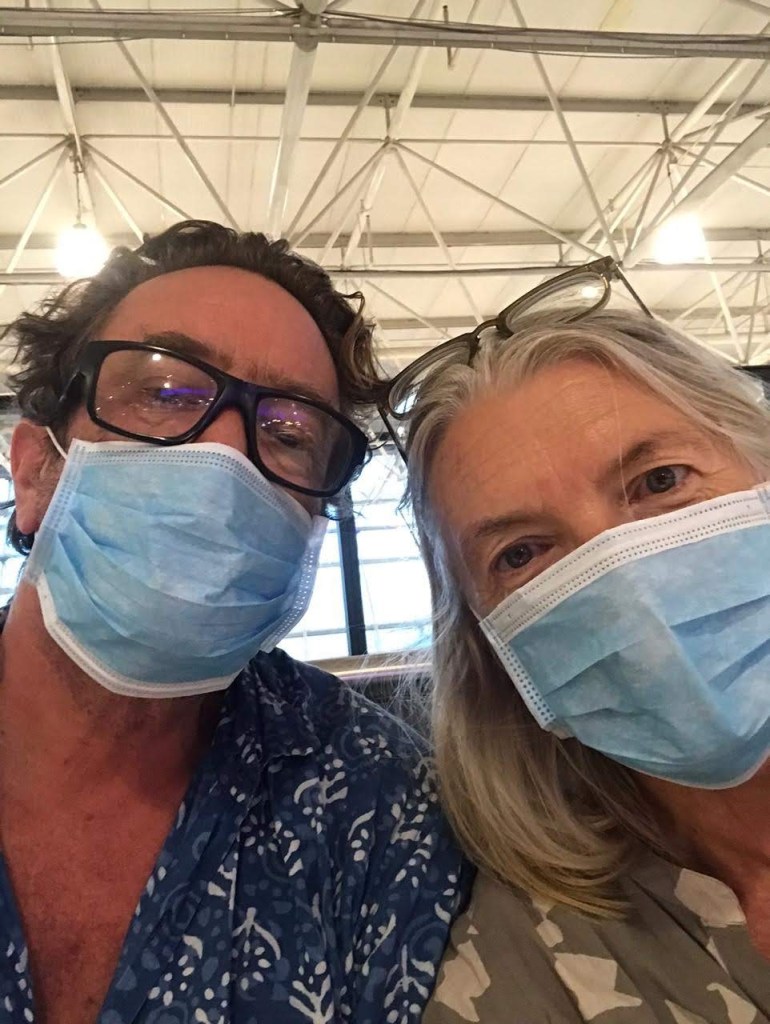
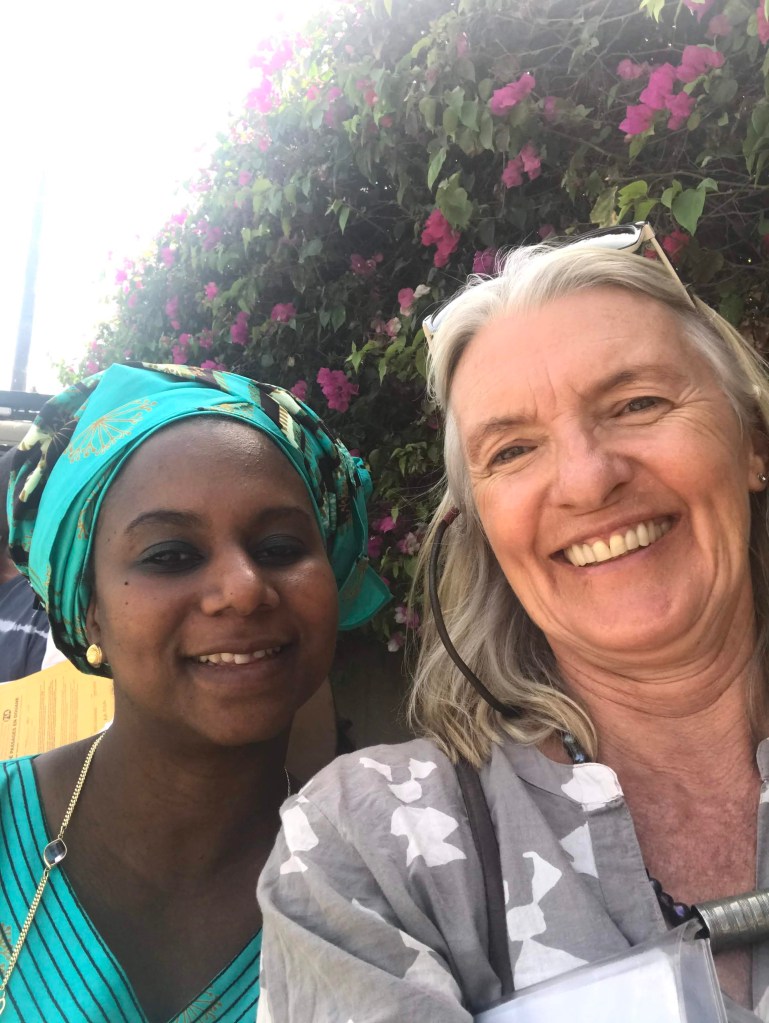
Dakar airport look like an evacuation centre. The tension in the air is palpable. People are stressed out and frantic. Everyone has masks that they have bought in the airport from traders for dollar prices. Anyone Asian is wearing full white overall suites with masks, looking like land astronauts. Everyone is finding their way home somehow. Just like us. Its weird. Surreal. We decide to follow the masses and buy a mask each. Head through immigration and security. Find a coffee and start the long wait for our midnight flight. We are relieved and exhausted, even though it’s only midday. We feel we have made big progress. We just have to hope that our flight does indeed take off. Then we are free to get back home. No doubt at that.
As things transpired, we boarded and took off completely on schedule. Rising above the earth literally ten minutes before the midnight hard stop airport closure deadline. Everyone on the plane is shouting hooray in a mixture of joy and relief as we lift off. We fly to Addis and spend another day there before flying to Johannesburg. We are relieved beyond measure. Mission accomplished as best as we can.
I am filled with this overwhelming sense of gratitude. Gratitude to the ancestors who looked after us in our hour of need. Gratitude to the Senegalese staff at Safmarine who cared for us and our vehicle in the heat of the crisis. Gratitude for having been blessed with six months of travel through the most challenging roads and rivers and forests of west Africa. Gratitude for the baseline simple kindness of the ordinary West African people, for the way they held us and cared for us throughout our journey. We will be back.
 Africa Overland
Hope you have continued your journey on the long way round, complete your dream. Take the east road, drive through the centre and head back to Senegal. Take up offers to meet and support offered you there. Invite MrP and his Overlander Dream to join you on the next leg of your journey. Rubber on the Wheel is calling you to roll onwards …
LikeLike
Captivatingly written Gavin! Hope you both are well! I sincerely hope that at some point in time you will be able to complete your journey around this wonderful continent.
Our overlanding trip had also been cancelled due to the pandemic but it will now go ahead at the end of this year with a slightly different itinerary and composition.
Cheers, Ulrich
LikeLike
Riveting read beautifully written Gav😮👍🏻
LikeLike
Thanks so much for sending this, Gavin. What a story.
I hope you’re well, in one of your beautiful places.
Love Eliza xx ________________________________
LikeLike